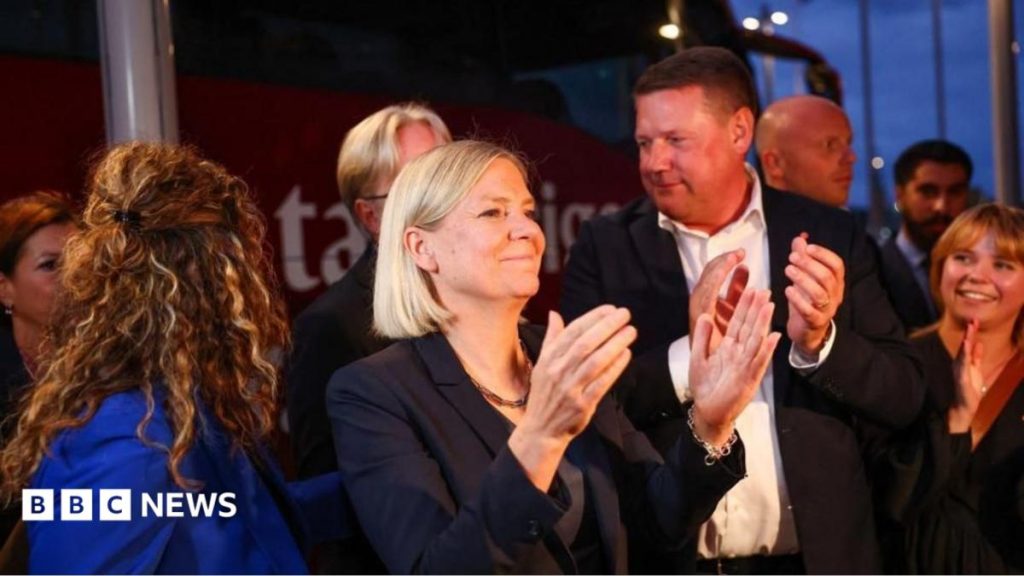
Magdalena Andersson is seeking to return as prime minister – a job she held from 2021 to 2022
Published13 September 2026
Sweden's general election remains too close to call with the left-wing bloc marginally ahead as the vote count continues.
With more than 90% of ballots processed early on Monday, the left-wing bloc was in front by approximately 20,000 votes.
Preliminary counts by Sweden's electoral authority projected the Social Democrats' Magdalena Andersson would likely finish with a three-seat majority over the rival four-party coalition led by current conservative Prime Minister Ulf Kristersson.
Kristersson has been supported in government by the hard-right Sweden Democrats (SD), which have neo-Nazi roots. He has promised cabinet jobs for the SD if he stays in charge.
Close race in Sweden as hard right eyes role in governmentPublished2 days ago
Early on Monday morning, Kristersson said it remained unclear who would form the next government.
"The voters have had their say, but we still don't have a final result. Which government will lead Sweden in the coming years is still an open question," he told supporters.
No major media outlets have declared a winner yet.
Sweden uses a mandate distribution voting system, a proportional representation method to elect "mandates", or "seats", in the Riksdag – the Swedish parliament. A party needs at least 4% of the vote to enter parliament.
With 95% of votes reported, the left-wing bloc led by the Social Democrats was ahead with 176 mandates compared to the right-wing bloc's 173.
Counting will continue on Wednesday before the final results determine which side has a clearer path to majority.
The counting restarts then to include early votes that were submitted late, as well as votes from abroad that did not arrive before election day.
It is not yet known how many votes will be counted on Wednesday, but back in 2022, more than 220,000 votes were included in the later count.
If the figures are similar this year, Wednesday's count could make the difference in the outcome, given that only about 28,000 votes currently separate the blocs.
Sweden has two major political blocs featuring four parties on the right and four on the left – meaning coalition and minority governments are relatively common.
On Sunday night, Andersson – the leader of the country's main opposition party – urged supporters to wait for the final result, but added that if the current results hold, "Sweden will have a new government."
Her party, the Social Democrats, have been a major force in Swedish politics since the end of World War Two.
But SD – founded by Nazi sympathisers in the 1980s – had been shunned for years until 2022 when it became the country's second largest party after campaigning on violent crime and immigration.
Both Andersson's party and the far-right SD have lost support, according to early count results.
As of Monday morning, the Social Democrats were on track for their worst result in more than a century with 28 per cent, while the count showed the hard-right SD party was losing support for the first time since 2010 when it entered the Riksdag.
Other parties comprising the left-wing bloc, including the Left Party, Greens and Centre Party have increased their support.
Turnout also dropped to approximately 80%, down four points compared to the 2022 poll.
After casting her vote on Sunday, Andersson laid out the choice facing the Swedish public: "Should we have a government entirely dominated by the Sweden Democrats, something that has never happened in Sweden before? Or should we have a government led by me, which will steer Sweden in a new spirit of co-operation?"
Kristersson, for his part, said it was important he and his alliance were able to continue their work.
"I think there is a genuine enthusiasm for us being able to continue our important work," he said after casting his ballot in his home municipality of Strangnas.
National security, gang crime and welfare spending dominated the election campaign.
منبع: بی بی سی