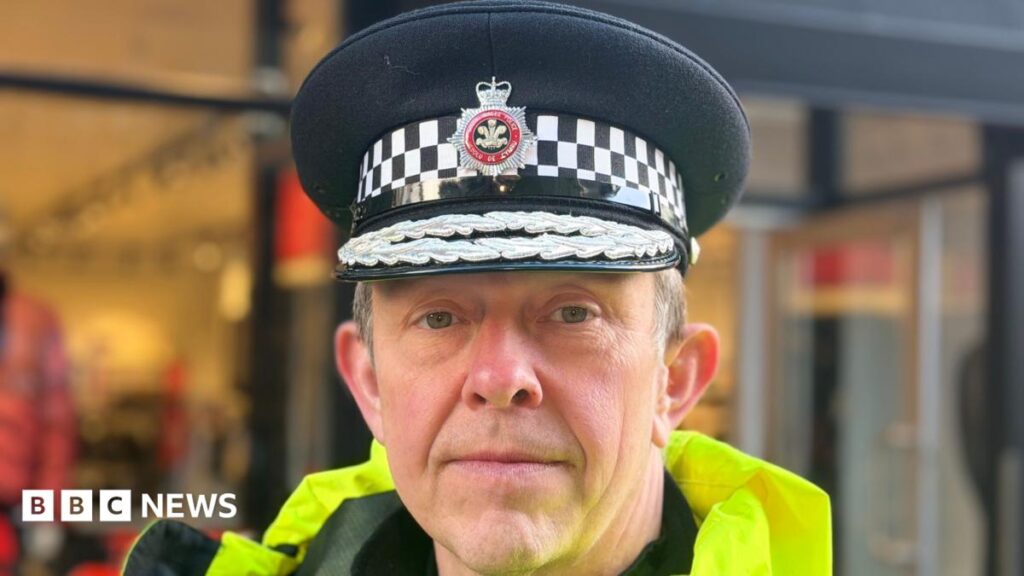
Chief Constable Jeremy Vaughan told MPs he would "excommunicate" racists and misogynists from South Wales Police
Published36 minutes ago
The chief of Wales' largest police force says he is working to root out racists and misogynists from his organisation as part of efforts to improve trust in officers.
Chief Constable Jeremy Vaughan had responded to a question from MPs about how he and other police chiefs were clamping down on staff misconduct "in a post-Sarah Everard era".
The South Wales Police chief said: "Do I think I've got racists, misogynists, working for me? Yes. Do I think my work is to find them and excommunicate them from policing? Absolutely yes."
He appeared in front of the Welsh Affairs Committee on Wednesday, along with Wales' three other police bosses, as part of its inquiry into the future of policing.
One of the issues being examined by the committee, made up of Welsh MPs from the UK Parliament, is a UK government proposal to reduce the number of police forces in England and Wales.
Committee chairperson, Newport West and Islwyn MP Ruth Jones, had asked the chief constables of all four forces how they were evaluating their forces' performance when it came to addressing misconduct.
Jones noted in her question that "we're still in a post-Sarah Everard era", referencing the 33-year-old woman who was abducted, raped and murdered by serving Met police officer Wayne Couzens in London in 2021, and that "there have been issues across Wales".
Vaughan said that 126 people had been dismissed from the force under his watch since he started his role six years ago, and that he believed it had been "significantly higher" under his predecessor.
Saying he believed improvements to vetting and training meant his organisation was now "more upstanding than by-standing than ever before", he noted that 22 people within it were currently suspended – which he said was a "low proportion of the workforce".
He said that identifying and sacking racists and misogynists from within South Wales Police was a "whole-organisation leadership effort".
The four chief constables appeared at the committee hearing in Westminster on Wedmesday
Dyfed-Powys Police Chief Constable Ifan Charles told the committee he had a number of people currently being investigated for gross misconduct, some of whom were currently suspended, and that "some of those are for misogynistic behaviours".
North Wales Police Chief Constable Amanda Blakeman said her force had "pursued individuals that should not be in policing" and had been "relentless in all aspects in terms of anti-corruption, information from the public, about how we'll deal with people who don't live up to" her force's standards.
Gwent Police Chief Constable Mark Hobrough admitted his force had previously had a "very different culture" with high-profile senior leaders "who did not represent the values of modern day policing" removed from it.
He said the force currently had 37 active misconduct cases and 14 people suspended.
He said a staff survey indicated high levels of confidence in reporting misconduct and that the force would deal with them.
Elsewhere in the committee the police chiefs were asked for their views on the UK government's policing White Paper published in January.
It proposes significantly reducing the number of forces in England and Wales by merging existing forces into larger ones. A review will propose the best way to organise the new forces and no final decisions have yet been taken.
Wales currently has four forces, but there has been speculation it could go down to one, as is the case in Northern Ireland and Scotland.
Blakeman told MPs she thought the current structure should remain in place.
"I'm genuinely concerned about the prospect of force mergers because of that difference that we see in north Wales, and I'm concerned about the impact that those mergers may have in terms of our communities and the service they get," she said.
"Anything that is centralised tends to see service reduced in our rural communities, of which there is a large scale across north Wales."
She said delivering for rural communities would be "significantly at risk" if Wales went down to one force.
"I'm concerned about the vulnerability and isolation that we would see in the furthest part of north Wales that's disconnected from the point of view of road infrastructure, ability to travel, and is more connected to the North West of England," she added.
Vaughan said a restructure of forces could deliver efficiencies but must be properly funded.
He said he broadly agreed with the "direction of travel" set out in the government's proposals.
But added: "It's quite hard to analyse the specifics because I don't know what they are yet."
The UK government has been approached for comment.
منبع: بی بی سی