
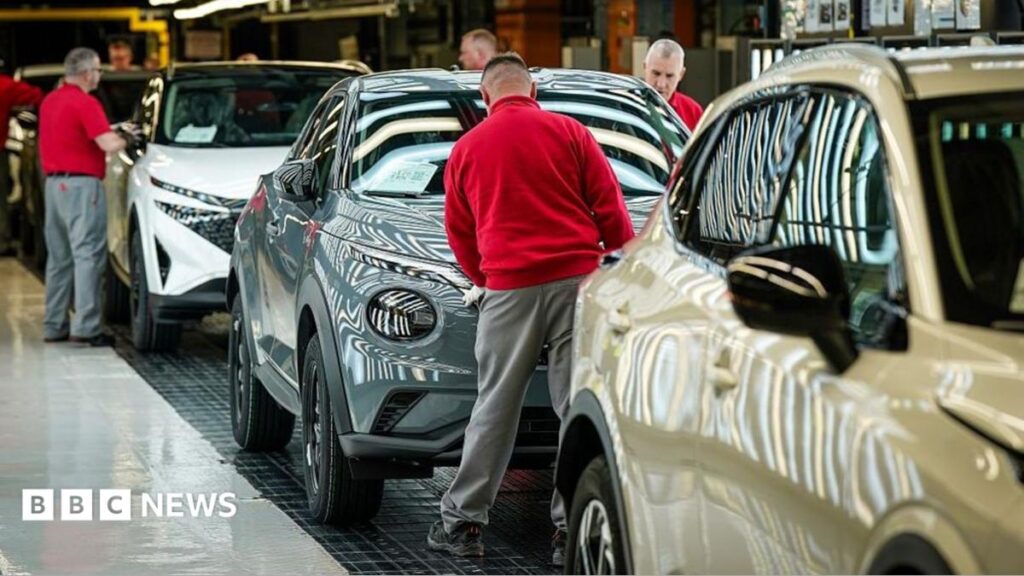
Current rules say all new cars must be zero emission by 2035
Published59 minutes ago
The UK is likely to miss legally binding climate targets if the government reduces electric vehicle (EV) targets, independent adviser the Climate Change Committee (CCC) has warned.
In a letter to Transport Secretary Heidi Alexander, the CCC argues that weakening the targets would result in "economic and energy security costs" and leave households "more exposed to volatile fossil fuel prices".
The CCC says that switching to an electric vehicle can save a typical household around £800 a year, with fewer people benefiting if the targets were watered down.
The warning comes after weeks of speculation that the government plans to announce changes to the EV targets. Government sources insist no decision has been made.
Under the current rules, a "zero emission vehicle" (ZEV) mandate requires 80% of new cars sold in the UK to be zero emission by 2030 and all new cars to meet that standard by 2035. Companies that fail to meet their ZEV mandate face a potential fine of £12,000 per car, although there are exemptions.
Industry groups have long complained the current rules impose too heavy a burden, calling instead for a "sustainable transition".
Latest data from trade body the Society of Motor Manufacturing and Traders (SMMT) shows that EVs, as well as plug-in hybrids, are driving growth in new car sales.
In the year so far, 26.6% of all new car registrations have been fully electric, the SMMT says, which is below the headline target of 33% for 2026.
But the industry as a whole appears on course to comply with this year's mandate once flexibilities are accounted for, according to analysis by New AutoMotive, a transport research organisation which supports the transition to electric cars
SMMT Chief Executive Mike Hawes accused the CCC of ignoring the costs of the targets it was defending.
"The industry cannot subsidise the transition indefinitely, which is why it is unified in seeking change," he said.
The CCC analysis also argued that weakening the targets would lead to a hole in the government's carbon savings that need to be made in order to meet its legally binding climate targets.
The CCC said the ZEV mandate "underpins the largest share of emissions reduction to 2037" in the government's net-zero plan. The climate targets set for 2033-2037 will be missed "without alternative action at the same scale", the CCC argued.
CCC analysis shows surface transport – which includes cars, vans and trucks – remains the country's highest carbon-emitting sector and one of the slowest to decarbonise.
Lord Deben, former CCC chairman, said going against CCC advice would "not be sensible" as it would "cost people money".
He said climate targets were "not random targets" and "if you don't reach them then you put yourselves in really serious danger of having climate change, which we can't handle".
A government spokesperson said: "We remain committed to the phase out of all new petrol and diesel cars by 2030 and to all new car and van sales being zero emission by 2035, as well as to our legally binding net zero targets. Our consultation on the Mandate will not change this and will ensure we are taking a pragmatic and balanced approach to the ZEV transition."
منبع: بی بی سی