
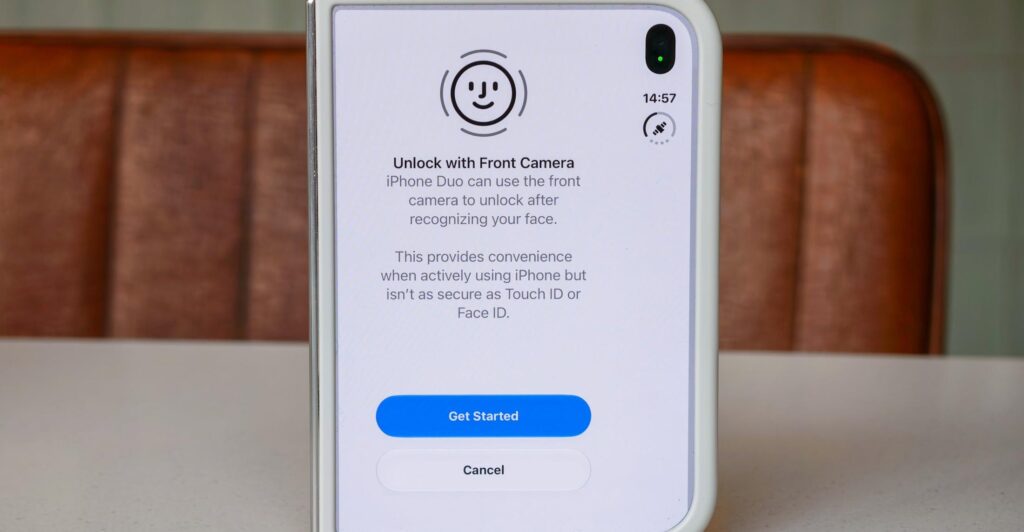
Apple is testing adding face unlock to the iPhone Duo — not true Face ID, but something a little simpler and less secure. So far, it works great, and even with a few Apple-imposed security limitations, it makes the Duo quicker and more comfortable to use than relying on Touch ID every time. That’s one of my gripes with the phone taken care of. The Duo’s foldable architecture means that Apple couldn’t fit in the full Face ID sensor array found on the rest of the iPhone lineup (though it reportedly hopes to change that by the second generation).
Instead, it simply has two selfie cameras — one on the outer display, and another hidden under the inner one. Neither supports full Face ID, but after enough grumbling from reviewers and early adopters that using Touch ID alone feels cumbersome, Apple has relented. The latest developer beta of iOS 27.3 introduces a new option to “Unlock with Front Camera” — Apple is careful not to call it Face ID. Setup is similar, though instead of rotating your head in a slow circle, you simply have to turn it left, right, up, and down.
It takes five seconds or so, and I even managed it under the jerky conditions of a moving London bus. [Image: Setup takes only a few seconds and is similar to Face ID. https://platform.theverge.com/wp-content/uploads/sites/2/2026/11/iphone-duo-face-unlock-3.jpg?quality=90&strip=all] The new face unlock brings convenience, taking just half a second to unlock, but Apple warns during setup that it “isn’t as secure as Touch ID or Face ID” because it lacks the infrared depth map of the TrueDepth cameras.
That means it’s possible to spoof with a photograph or video clip, but I managed that only once in over 20 attempts. Crucially, after each failed attempt to trick the system with a photo, the phone demanded I use Touch ID for my next login — which it doesn’t require if it simply doesn’t detect any face in the frame. That means getting past this would require any would-be thief or spy to get the fake face right the first time. Lacking TrueDepth also introduces limits in low light, though performance is better than I expected.
Walking around after sunset, I had to seek out especially dark spots before I could find anywhere where unlocking failed, like huddling behind a truck on a leafy street where the streetlights couldn’t reach me. It will fail eventually, but it does have to get quite dark for that to happen. Apple has imposed a few other limitations to reflect the lower security of the new system.
You can only use it to unlock the phone from the lockscreen, so you will have to revert to Touch ID or a passcode to use Apple Pay, install or log in to an app, or get past any other screen where the phone requires security credentials. That’s similar to most Android phones with camera-based face unlock. Only Google’s Pixel phones allow you to make purchases or log in to apps using Face Unlock, thanks to software tricks that make the system more secure than other Android alternatives, Google says.
[Image: https://platform.theverge.com/wp-content/uploads/sites/2/2026/11/iphone-duo-face-unlock-4.jpg?quality=90&strip=all] [Image: https://platform.theverge.com/wp-content/uploads/sites/2/2026/11/iphone-duo-face-unlock-5.jpg?quality=90&strip=all] The iPhone Duo’s more annoying limitations reflect when you can use the feature. Face unlock works only for 45 minutes at a time, after which you’ll have to verify with Touch ID or your passcode the next time you unlock. Worse, it doesn’t work at all with the inner screen’s under-display selfie camera.
Apple hasn’t said why, though presumably it felt the lower resolution and quality of that camera made face unlock unsuitable. I’d love it if Apple loosened its restrictions just a little — 45 minutes isn’t a very long time before requiring Touch ID again, and I’m sure I’ll regularly forget that the inner screen requires a fingerprint. But the Duo already feels more comfortable to use, letting me get straight into the phone rather than fumbling for the fingerprint sensor.
It’s small, but it’s a welcome sign that Apple is listening to the Duo’s early users and is willing to adjust its grand vision to meet the world where it is. For now, face unlock is limited to the developer beta, but it could roll out to a public beta within a few days, and with luck will get a full launch along with the rest of iOS 27.3 in December. Now can we get the same option for MacBooks and iPads? Photography by Dominic Preston / The Verge
منبع: ورگ