
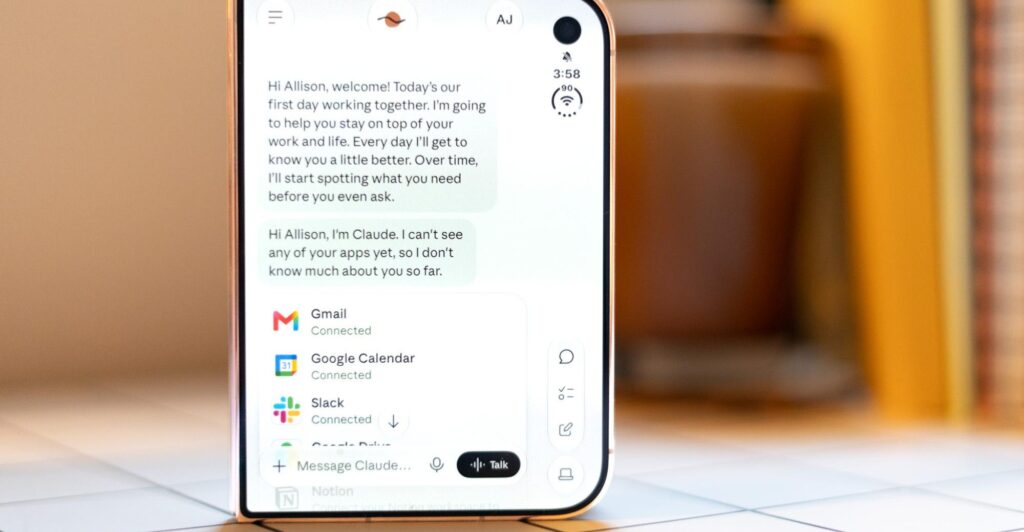
Normally, the products I test don’t offer to help me write up my experience with them. Duet is different. Claude Duet is Anthropic’s AI agent for consumers, the latest attempt by an AI company to try to convince us that agents can be useful for people who don’t write code. It’s been an interesting couple of months: Instinct gave us an impressive text-based assistant, Meta offered us its cute little guy, Muse, to help us buy things, and OpenAI gave us the more work-oriented Dots. Claude Duet is even more focused on work than those.
It’s also more consumer-friendly than Claude Cowork, which was more consumer-friendly than Claude Code — the coding agent that kicked off a whole hype cycle earlier this year. I’ve been testing it over the past week as I navigate a busy travel and work schedule. At turns it has been truly useful, kind of a nag, and very eager to write about itself. Duet is still a “research preview” according to Anthropic, and access is limited to Pro, Max, and Ultra subscribers in the US, with a waitlist to join.
It’s not here to order you burritos, either; it’s for “professionals and small business owners” and is meant to use its judgment about what needs your attention most. Like Meta’s Muse, Duet has its own app. (If you’re keeping score at home, yes, it has been updated to fully support the iPhone Duo). Duet uses Claude’s characteristically cheery, minimalist design. The app is consumer-friendly and approachable.
Once you’ve connected all the productivity and chat services you want, it’ll look for ways to help out with and suggest them as cards you can swipe left or right to hide or accept — kind of a to-do list Tinder. In the name of testing, I went all in on Duet and gave it everything: my work email, calendar, Google Docs, and Slack. This gave it plenty of grist for the mill in more ways than I’d even realized at first.
Because our biweekly staff meeting is automatically summarized in an email from Gemini, and Duet had access to my email, it was able to connect the dots between something said in a meeting and a direct message in Slack. Duet also worked out who my boss is because we have a shared Google Doc for our weekly 1:1 meetings. AI is at its most useful when it can suck up lots of data, and Duet wasted no time doing so.
[Image: https://platform.theverge.com/wp-content/uploads/sites/2/2026/11/IMG_3369.png?quality=90&strip=all] [Image: https://platform.theverge.com/wp-content/uploads/sites/2/2026/11/IMG_3417.png?quality=90&strip=all] Duet has started each morning by greeting me with a brief message and some quick highlights for my day, like reminding me to pack an item required for a video shoot before my flight. Below that, it would suggest to-dos, usually ending in an offer to help draft a message or add an item to an agenda.
This has often been helpful, though it sometimes felt like interacting with a slightly neurotic personal assistant. In one instance, I’d emailed someone I interviewed for a story that the article was likely to go up on Tuesday and that I’d send a link when it did. I submitted my draft to my editors late at night on Monday, and Tuesday morning Duet was beside itself. It wasn’t quite 9AM yet when it pointed out that the story was still waiting for an edit and I needed to get on that — or else I wouldn’t be able to send the link I promised.
The concern was a bit misplaced. And it didn’t pick up on the nuance in my message implying that this was not a hard deadline, nor the fact that it was only 7AM local time for my editor. In other cases, it was surprisingly helpful. In planning out the next few weeks I’d missed the fact that upcoming time off would only leave me with a couple of working days before another big draft was due. Duet proposed a solution, offered to update the Google Doc with weekly notes for my editor, and drafted a Slack message for him noting the update.
Reader, the message was a little too good. It copied my millennial habit of writing in all lowercase — which it pointed out in a slightly self-congratulatory aside — and used an abbreviation we often use to refer to our CMS. But it also shortened the word “signature” to “sig,” which I never would and made me laugh out loud. In any case, there’s no fooling anyone; the Slack message was tagged with a “sent with Claude” label. Duet often volunteered to help start my drafts, which is always a hard no for me.
I’ll type up my own little blogs, thank you very much Claude. If you’re not a writer, I can see how taking care of little writing chores here and there would be helpful. But this started feeling like a Spider-Man-pointing-at-Spider-Man moment when the task it wanted to help with was reviewing itself. It was a little uncanny, too. Even setting aside the fact that I was writing about Duet, it’s kind of weird knowing that it can read every email, draft, and Slack I send.
It can read all of that because I opted in to sharing that data, and I knew full well what I was doing. But it’s another thing to see it in practice. I wonder if it would change how I work if I knew I didn’t really need to take responsibility for putting things on my calendar, writing down a to-do list, or paying attention in a meeting because Duet will just handle it. Maybe that’s how CEOs live. Not that I cherish creating calendar entries, but I wonder if I would end up feeling a bit disconnected from my workplace.
I don’t think Duet or any other AI agent is quite ready to make us feel like we’re all the CEOs of our own little worlds. There’s a key word in the title “personal assistant”: personal. A person can pick up on nuances in tone to understand what’s a big deal and what isn’t. A person will pick up on communication norms and deploy them sensibly. A person can be tactful. Anthropic’s blog post mentions that the company is continuing to “test its judgment about when to message you,” so it’s possible Duet will calibrate a little better over time.
But AI overall isn’t good at understanding nuance or tone, and it’s not clear if it ever will be. For me, Duet made it a little more clear what I want AI to do for me and what I don’t. Communication happens all over the place in a modern workplace — in emails, DMs, meetings, shared docs. Having AI find discrepancies that have been overlooked between all of these sources and point them out proactively is really helpful. I like it as a backstop for my own organizational systems, not as a replacement for them. I don’t like it in the creative process.
Like, at all. I want to find “my own ways into and around a topic,” as Hank Green said of his own reliance on AI. If you send a robot to do the legwork, you miss the opportunity to stumble across something unexpected. It’s part of what makes the work enjoyable. And I’m certainly not about to let an agent review itself for me. You hear that, Duet?
منبع: ورگ