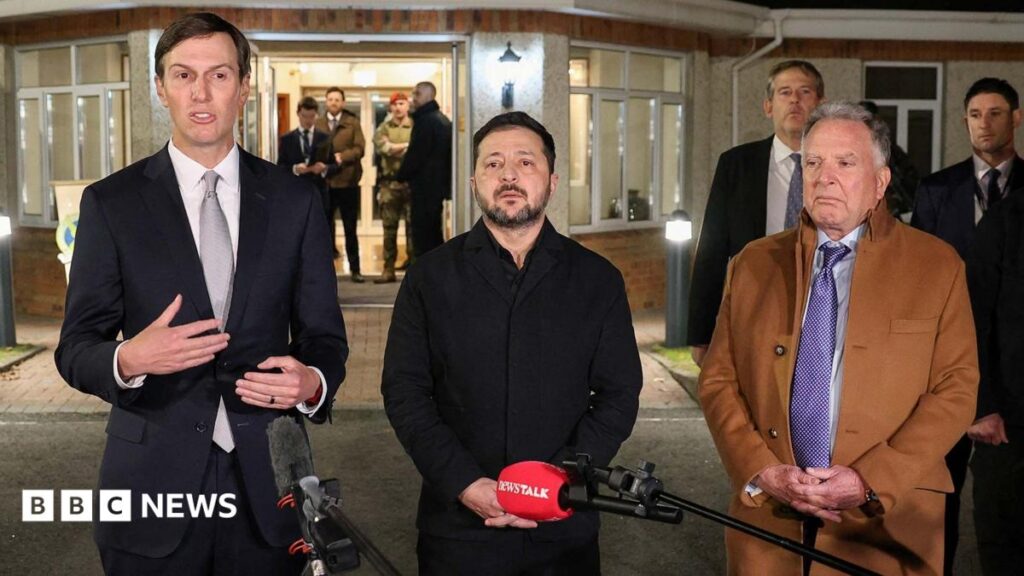
US envoys Jared Kushner (left) and Steve Witkoff (right) met Volodymyr Zelensky in Dublin on Thursday evening
Published9 hours ago
Ukraine's president has welcomed a pledge from US envoys, Jared Kushner and Steve Witkoff, to include delegates from the European Union in the next round of peace talks with Russia.
European leaders have expressed deepening security concerns this week, and Volodymyr Zelensky said bringing them into the talks would ensure the EU has a "voice" in negotiations.
Kushner and Witkoff met Zelensky in Dublin on Thursday evening as part of a busy day of shuttle diplomacy – they met Vladimir Putin in Moscow earlier, who said that Russia's position on the war – and its demand for territory – has not changed.
The meetings follow talks in Abu Dhabi last week that failed to reach a breakthrough in ending the war.
But Thursday did see Russia and Ukraine agree to another prisoner exchange – the largest swap yet since Russia launched its full-scale invasion in 2022.
Kushner said it would return "thousands of people to their families", but there were no further details over how many prisoners would be exchanged or when it would happen.
US envoys meet Zelensky in Dublin after talks with Putin in MoscowPublished14 hours ago
Europe's security 'fundamentally reshaped' by war in UkrainePublished20 hours ago
Zelensky has for several years been calling for European delegates to be included in the peace talks, and says it makes sense because of Kyiv's longer-term ambition to join the European Union.
On Thursday, Kushner said that the US has been "working very, very closely over the past several months with Europeans and I think that that's been very important."
He added that he had stressed to Putin how important it was to have European delegates "at the table".
"He's willing to give it a try," Kushner added.
Ukraine and Europe have long been concerned about the current US government's commitment to European security and its softening towards the Kremlin.
Moscow has been dismissive of European involvement, although Europeans have long argued that they are central to any post-war dynamics on their continent.
Earlier on Thursday, the EU's foreign policy chief, Kaja Kallas, told the BBC's Newshour the presence of a European delegate showed the Kremlin "now realised that Europe is a big player".
Kallas also expressed doubts that there was Russian momentum towards a peace deal.
Taoiseach (Irish Prime Minister) Micheál Martin told a host of European leaders gathered in Dublin on Thursday that he believed the security of the region had been "fundamentally reshaped" by Russia's war.
"Many member states [of the EU] feel an existential threat because of what has happened in Ukraine and the potential, if Ukraine was to fall, for further aggression on the European continent," he told reporters.
Russia's full-scale invasion of Ukraine began in February 2022. Approximately one-fifth of Ukraine is now under Russian occupation and Kyiv has refused Putin's demand to give up areas of Ukraine's eastern Donbas that remain under its control.
Tensions between the US and Ukraine were on display on Thursday before Witkoff and Kushner's meeting with Zelensky.
Earlier, the Ukrainian leader said that the military was facing more "systematic" restrictions to Starlink's military-grade satellite service, Starshield, meaning Kyiv was struggling to intercept Russian jet-powered drones.
Starshield technology, which was developed by Elon Musk's SpaceX company for government and military use, has played a vital role in facilitating communication on Ukraine's front line.
منبع: بی بی سی