
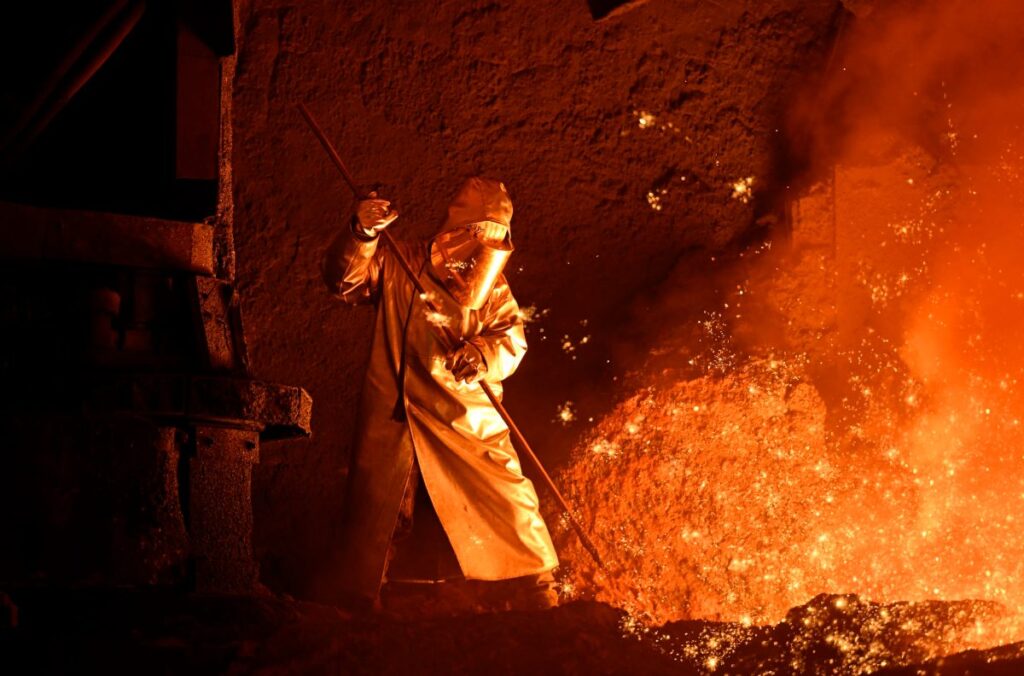
The iron and steel industries are among the biggest polluters in the world. Plenty of startups have tried to cut the industry’s emissions, mostly by developing new ways to make the metals. Helix Carbon thinks those startups have been going about it all wrong.
“Any attempt to decarbonize the steel industry without dealing with the blast furnace is not going to work,” David Brown, Helix Carbon’s co-founder and CEO, told TechCrunch. A blast furnace is the giant furnace that turns iron ore into the iron used to make steel. Rather than replace blast furnaces, Helix wants to clean them up. Its approach promises to slash the steel industry’s carbon emissions while boosting profit margins for iron producers, a rare win-win for a dirty industrial process.
Blast furnaces have made iron for centuries, using coke, a processed form of coal, to help turn raw iron ore (iron bound up with oxygen) into metallic iron. The burning coke supplies heat for the reaction but doesn’t take part in it directly. Instead, carbon monoxide produced from the combustion does the work of reducing the iron, meaning stripping away its oxygen atoms.
The process releases tremendous amounts of carbon dioxide, or CO2, which is normally dumped straight into the atmosphere. But Helix Carbon has devised a way to turn that waste carbon dioxide into carbon monoxide and recycle it back into the blast furnace.
Helix Carbon’s process relies on an electrolyzer, a device that uses electricity and a catalyst to break off an oxygen atom from the carbon dioxide. Electrolyzers aren’t new, but Brown said the startup’s design can handle the entire exhaust stream from the blast furnace. Most electrolyzers are too delicate for raw exhaust like that. They work only on purified, concentrated carbon dioxide, so the exhaust typically has to be processed before they can use it.
By injecting carbon monoxide into a blast furnace, iron producers can use less coke. How much, exactly, is still debated, Brown said. Some scientific papers suggest as much as 90% of the coke can be eliminated, while other studies suggest it’s more like 30% to 40%.
Helix Carbon is proposing that iron producers start by replacing 33% of their coke. The company says using its technology to do so would save them $14 per ton of iron. “That may not seem like a lot, but margins in the iron industry are famously thin,” Brown said.
The iron and steel industries are a combined $2 trillion market, according to Grand View Research, which makes the sector an appealing target for a young startup to chase. But it also moves slowly, in part because its equipment lasts so long. “There are blast furnaces that have lived for over 100 years,” Brown said.
To bring in revenue earlier, Helix Carbon plans to court the specialty chemicals industry first. “We don’t need to capture the CO2 first,” Brown said. “We just utilize it, and that opens up the door of making chemicals on site right out of waste streams.”
Helix Carbon is part of the Startup Battlefield pitch competition and presented live on stage at TechCrunch Disrupt in San Francisco on Tuesday. Join us this week to watch as the rest of the Battlefield unfolds.
When you purchase through links in our articles, we may earn a small commission. This doesn’t affect our editorial independence.
Senior Reporter, Climate
Tim De Chant is a senior climate reporter at TechCrunch. He has written for a wide range of publications, including Wired magazine, the Chicago Tribune, Ars Technica, The Wire China, and NOVA Next, where he was founding editor.
De Chant is also a lecturer in MIT’s Graduate Program in Science Writing, and he was awarded a Knight Science Journalism Fellowship at MIT in 2018, during which time he studied climate technologies and explored new business models for journalism. He received his PhD in environmental science, policy, and management from the University of California, Berkeley, and his BA degree in environmental studies, English, and biology from St. Olaf College.
You can contact or verify outreach from Tim by emailing [email protected].
منبع: تک کرانچ