
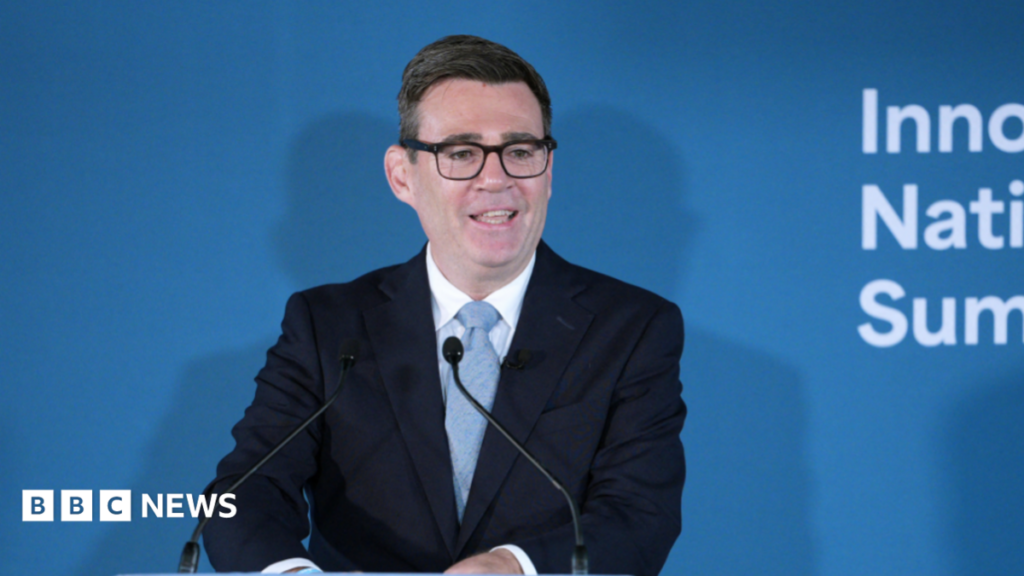
Andy Burnham has promised to curb companies' ability to restrict what their workers can do after leaving their job.
In a speech, the prime minister said the use of non-compete clauses in employment contracts had "gone too far" and was holding innovative UK companies back.
He added the clauses had forced workers to go without pay after leaving a role, as well as making it harder for growing firms to hire new staff.
Ahead of the Budget later this month, he also said there was "more to do" on tax to encourage promising firms to stay in the UK.
Sir Keir Starmer's government had been exploring possible restrictions on non-compete clauses since late last year, including a total ban, banning them above a certain salary threshold, or limiting how long they can last.
Although commonly associated with the financial services and technology sectors, research cited by the government has estimated around 5 million jobs in Britain are covered by the clauses, typically lasting around six months.
Speaking at a business summit in Manchester, Burnham confirmed his government would press ahead with new legislation to ensure the clauses can "no longer be a barrier" to hiring new staff.
He added that their use had stopped workers leaving to join other companies, or founding their own firms instead, adding: "I think that's a drag on innovation."
Referencing a landmark 1995 court ruling that is credited with revolutionising the football transfer market in Europe, he said he hoped reining in non-compete clauses could prove the "Bosman ruling for the innovation sector".
Investor confidence concerns
Burnham did not specify the scope of the restrictions he is planning, but suggested they would apply to the "everyday economy" as well as helping "promising start-ups and scaling firms".
It is understood that the government is planning to unveil details of the proposed restrictions, which were first reported by Politico, external and The Financial Times, external, alongside the Budget on 28 October.
The previous Conservative government had ruled out a total ban, external on non-compete clauses, after hearing from employers that it could reduce investor confidence in the UK or prompt companies to tighten how they share information internally.
The prime minister sought to frame the announcement on non-compete clauses as part of a wider government pitch to boost innovative sectors of the economy.
He told the summit that although the UK was home to outstanding research and start-ups, too many companies had gone abroad in search of investment.
He also signalled that the government would "say more" at the Budget about plans to use public investment as a way to encourage private funding in the economy.
He added that he wanted all UK regions to have a dedicated fund to do this, modelled on the Good Growth Fund launched in Greater Manchester last year, during his tenure as mayor of the city-region.
He also hinted that the government was looking at the tax system to ensure the UK can retain high-growth companies.
He said: "One of our biggest challenges is breaking through our own ceiling. Too often, our best ideas are developed and scaled overseas, and with it the jobs, technology and investment that goes with them."
"So I know there is more to do to fix that, specifically on tax, to encourage people to stay and scale."
منبع: بی بی سی