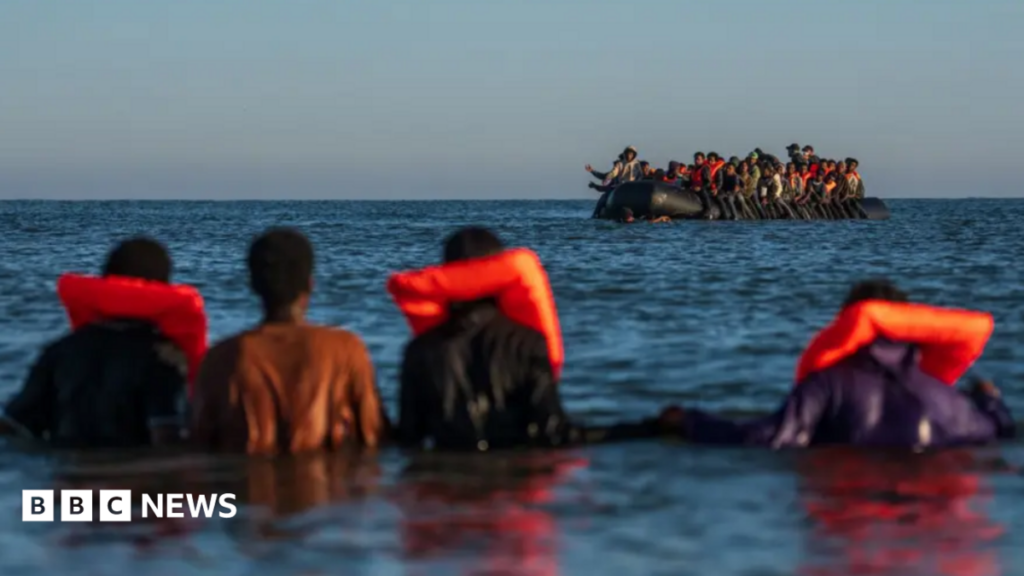
Smugglers have launched small boats from beaches much further from Calais and Dunkirk
Published6 hours ago
A growing number of migrants are trying to cross the Channel on small boats using longer routes from beaches further south and west of Calais and Dunkirk, French authorities say.
Last week one boat set off from Normandy and spent more than 30 hours at sea, before being intercepted and taken to Dover by Border Force.
Although attempts from Normandy have been rare, authorities in neighbouring Seine-Maritime say there have already been 58 attempts this year, up from 30 last year.
The government says it is bearing down on dangerous small boat crossings, with figures showing a sharp drop in arrivals this year.
Despite overall crossings dropping, the stretch of coastline used for smuggling appears to be widening.
Earlier this month another migrant boat was met by lifeboats from the Isle of Wight having set off from the Cherbourg area.
These locations are nearly 80 miles (128 km) from the beaches where many of the small boats have crossed in recent years, with those on board spending longer at sea.
Recent attempted crossings have started in parts of Normandy and the Dieppe area in Seine-Maritime
Audrey Baconnais-Rosez, the local government representative in Seine-Maritime, said: "The number of attempts to cross the Channel has increased in number and it is getting further and further from the north of France."
She added that authorities were "managing to stop half of them".
The number of gendarmes patrolling the coast within Dieppe and further to nearly the Le Havre area have been increased, she said.
"Nowadays it's about 50 gendarmes on the coast and we have nearly 20 police officers in Dieppe and the surrounding [area] to try to stop them," she said.
Baconnais-Rosez also said some smugglers were still attempting to use ferries to Newhaven in Sussex.
"We are still intercepting them and we are bringing them to justice as well," she added.
Audrey Baconnais-Rosez, the local government representative in Dieppe, says police patrols have been increased
Dr Peter Walsh, a senior researcher at the University of Oxford's Migration Observatory, says it is highly plausible that the new routes are due to police disrupting boat launches in northern France.
"It's not at all optimal for these boats to set off so far away from their intended destination," he said.
"Some of these journeys would not be 20 miles (32km) but 50 miles (80km) or even more, which substantially increases the danger of course on board the boats."
David McFarlane, a marine safety consultant, said the longer the voyage, the more risk of encountering hazardous sea conditions.
"If a low pressure system is developing over the Atlantic, it can mean that in advance of the winds picking up, a swell will start to increase, with the increased likelihood of sea sickness for some, which can lead to dehydration," he said.
"The wind of course can pick up very quickly and waves can get up to 3.5m (11ft) in height in the Channel.
"This increases the risk of the boat being swamped by sea water, with the obvious danger to human life by drowning or exposure."
Between 1 January and 27 September 2026, a total of 19,135 people crossed the English Channel by small boat from France. This was down by 42% on the same period the previous year.
These crossings have become the most common way for people to be detected entering the UK illegally since 2020.
Nearly all those who arrive by small boat claim asylum. Under international law, this means they are allowed to stay in the country while their asylum application is considered.
Small boat arrivals made up 40% of asylum applications between July 2025 to June 2026.
Boats that arrived in the UK from 28 September 2025 to 27 September 2026 carried an average of 67 people. This has more than doubled since 2021.
Experts say overcrowding in boats makes crossings riskier. At least 84 people died while attempting to cross the Channel in 2024, according to the United Nations (UN).
When looking at the scale of small boats crossings, the number of these arrivals is about 5% of the size of total immigration into the UK from January 2025 to December 2025.
The government has pledged to “smash the gangs” behind these crossings in order to reduce the numbers.
People from Eritrea accounted for 18% of all arrivals from July 2025 to June 2026.
In the latest figures covering January 2025 to December 2025, at least 2,335 people who arrived by small boat were found to be potential victims of human trafficking or other forms of modern slavery, according to the Home Office.
Another 4,712 people were detected entering the UK without permission via other methods including hiding in vehicles, travelling on ferries or through airports from July 2025 to June 2026. This was down by 17% on the same period the previous year.
There are also individuals who arrive legally, for example via a work or study visa, and then overstay their limit.
The total number of people who live in the UK illegally after arriving legally is not known.
So far, 2026 has seen 19,135 people make the Channel crossing, compared to 32,188 during the same period in 2025.
However, the Home Secretary ordered a review last week after two migrant vessels reached the Kent coast unintercepted.
A total of 781 migrants arrived in 10 small boats on Wednesday, the highest number for a single day this year, according to Home Office figures.
Tony Smith, the former director general of Border Force, said the smugglers would continue to adapt.
"We've seen the Normandy crossings and the undetected crossings," he said.
"They're not going to give up as long as the business model continues to exist and there's a market to bring migrants over from France.
"Every successful landing is a message to the next migrant waiting on a French beach that it's worth a try."
Tony Smith is the former director general of Border Force
A Home Office spokesperson said joint efforts had seen more than 48,000 crossing attempts prevented and 1,100 boats and engines seized since the election.
"Our efforts are having an impact, with the number of small boat crossings down significantly this year and the lowest number recorded for the month of July since 2020," they added.
"But we must go further, which is why we have signed a payment-by-results deal with the French to put 40% more boots on the ground on French beaches, along with a surge unit of 45 additional officers to bolster action in Western coastal areas."
Follow BBC Kent on Facebook, external, X, external, and on Instagram, external and listen to BBC Radio Kent on Sounds. Send your story ideas to southeasttoday@bbc.co.uk, external or WhatsApp us on 08081 002250.
منبع: بی بی سی