
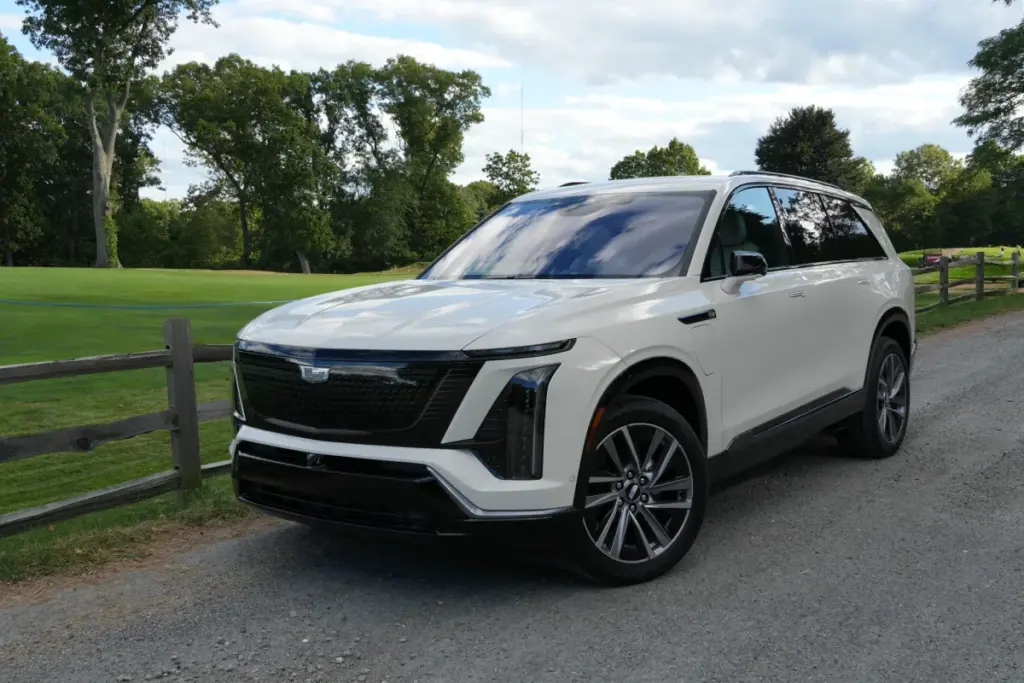
I don’t think I’ve ever described a leather-lined, 17-foot, 6,000-pound luxury SUV as a good deal, but the Cadillac Vistiq may have broken my streak.
Earlier this fall, I spent two weeks with a 2027 Vistiq Sport, one of Cadillac’s three-row electric vehicles, and I played a little game: I didn’t look at the window sticker for the first few days and instead tried to guess what it cost.
From the outside, the Vistiq looks rich, It’s stately and imposing, kind of like a baby Escalade, but not so imposing that it scared people away. In fact, I had more people ask me about the Vistiq than any other car I’ve tested or owned over the years.
The Vistiq can certainly make you feel a few inches taller, thanks to the ego boost from all the new attention — and also the slight step up as you slide into the driver’s seat.
The view from inside is also posh. A massive, 33-inch display dominates the dash. Plush leather and finely grained wood are everywhere, and the AKG sound system is really quite good if you manage to stream a high-quality recording. Thoughtful touches abound. My favorite was how, on a cold morning, the heaters for the seats and steering wheel would automatically turn on — not just to full blast, either, but to levels appropriate to the outside temperature.
The front seats offer a range of different massage types too. My favorite was “wave”, which runs the rollers down the length of your spine. Pro tip: Push against the steering wheel to get them extra deep into your knots. Top notch stuff. As the massagers did their work, I thought surely this vehicle must cost $100,000.
But not everything was perfect in this sleek machine.
GM’s advanced driver assistance system called Super Cruise is a well known quantity by this point. It works on roads that the automaker has mapped in great detail, and on those, it performs well, with a caveat: in many cases, it appears to need an internet connection.
Life without connections
When I first picked up the Vistiq in Manhattan, the vehicle wouldn’t connect to the internet. It turned out that the setup process for OnStar, GM’s connectivity suite, hadn’t been properly completed, though neither I nor the fleet managers knew that at the time.
Ultimately, I spent a full week with a car that wouldn’t connect to the internet. That might not seem like a big deal — some drivers might even want a more analog vehicle. But in 2026, it certainly can be, and it wasn’t what I was expecting from a pricey Cadillac.
The situation was made worse by the fact that GM doesn’t support CarPlay or Android Auto in its EVs. No internet meant no maps, no navigation, and no streaming audio. I made my way home from Manhattan glancing down at my iPhone, which was perched in a cupholder. Super Cruise didn’t work for most of the trip, either. My trip wasn’t posh, or particularly safe.
Having spent previous day on a train and attending New York Climate Week events, I wasn’t happy about driving four hours home without Super Cruise, but at least the plush suspension took the edge off. That and the massaging seats.
As much as I wanted the car to help with the driving, the Vistiq was a pleasure to drive. It’s no Porsche Macan Turbo, but it handles winding roads and freeway speeds as well as can be expected from a baby Escalade. The standard four-wheel steering and long wheelbase is also a real help in parking lots.
After a week with the Vistiq, I swapped it for the aforementioned Macan. GM and the fleet manager were able to figure out the problem and I was albe to get the same Vistiq to complete my testing.
Super Cruise worked, and as in my previous testing of the technology, I found it a capable if imperfect driving assistant. It still logs the occasional and seemingly random disengagement, but for the most part, handles freeway travel with aplomb.
GM’s infotainment system, which is based on Android Automotive OS, is also snappy and responsive. The voice assistant is easy to use, though it has a few quirks. The voice it uses to respond to queries is different from the voice it uses to issue navigation instructions, which isn’t a problem but is a bit jarring. Once, when I asked for Japanese restaurants near me, the Google-powered AI behind it started talking to me in Japanese.
GM has been making EVs based on the platform formerly known as Ultium for five years now. It’s a well-engineered platform, in many ways ahead of its time, though it’s starting to show its age.
The Vistiq, like many three-row SUVs, has the frontal area of a pickup truck, which means that no matter how slippery the designers make it, the EV is still fighting an uphill battle for efficiency. In my first week with the car, with temperatures ranging between 40˚F and 60˚F, I averaged 2.9 miles per kilowatt-hour over a mix of city and highway driving. Not bad, actually. The Lucid Gravity gets about the same.
Charging is another story. The Ultium platform runs on 400 volts, far less than today’s leading edge EVs. That kept maximum charging speeds on the low end, which means filling the 102-kilowatt-hour battery can take a while. At a Tesla Supercharger, which mates nicely with the standard NACS port, I topped out at 165 kilowatts after about five minutes of preconditioning and an initial state of charge of 18%. It took me 36 minutes to hit 80%. The Lucid Gravity seems to do better at Superchargers, and its 926-volt architecture means it can go even faster at more powerful stalls.
In reality, most Vistiq (and Gravity) owners will charge at home nearly all the time, which levels the playing field somewhat. These are luxury SUVs, after all.
The price is right, for now
Which brings me back to the price. The Vistiq I drove retails for $83,256, a price that includes destination charge and a handful of options such as second-row captains chairs and a 19.2 kilowatt onboard charger.
At that price, is the Cadillac actually a good deal?
Hear me out: In my garage right now is a Kia EV9 GT-Line. We bought it before the expiration of tax credits, and I was able to talk the dealer down on the price. But today the Kia EV9 GT-Line sells for $74,580 including destination charge. With two exceptions — the EV9 charges faster and its third row is more spacious — the Vistiq is far and away the nicer vehicle.
The EV9 is great, but the Vistiq feels like its worth far more than the $8,676 price difference. And compared with the Escalade IQ, which starts above $127,000, the Vistiq feels like a steal.
The Vistiq’s advantage may not last long. GM has reportedly put updates to the platform on ice while it reconfigures its EV strategy. Meanwhile, the EV world is moving quickly, and competitors are rapidly gaining experience with more advanced electrical architectures. BMW, for example, recently rolled out its new iX5, which can deliver as much range as I added in a third of the time.
For now, the Vistiq holds its own and GM needs to be careful not to squander its head start. Landing a good deal can boost your endorphins, but eventually, the rush wears off.
When you purchase through links in our articles, we may earn a small commission. This doesn’t affect our editorial independence.
Senior Reporter, Climate
Tim De Chant is a senior climate reporter at TechCrunch. He has written for a wide range of publications, including Wired magazine, the Chicago Tribune, Ars Technica, The Wire China, and NOVA Next, where he was founding editor.
De Chant is also a lecturer in MIT’s Graduate Program in Science Writing, and he was awarded a Knight Science Journalism Fellowship at MIT in 2018, during which time he studied climate technologies and explored new business models for journalism. He received his PhD in environmental science, policy, and management from the University of California, Berkeley, and his BA degree in environmental studies, English, and biology from St. Olaf College.
You can contact or verify outreach from Tim by emailing [email protected].
منبع: تک کرانچ