
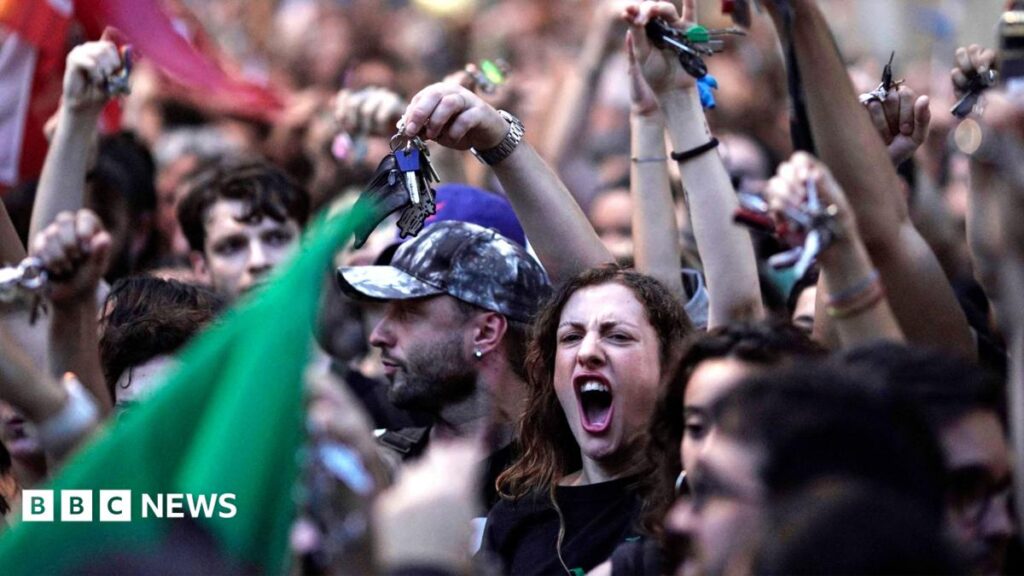
Jangling keys has turned into a symbol of protest against Spain's housing struggles
Spain's main party leaders have made their last pitch to voters in a fractious final TV debate that focused heavily on the country's housing crisis.
Spaniards go to the ballot box on Sunday, with opinion polls suggesting Socialist Prime Minister Pedro Sánchez will fail to extend his eight years in office.
The debate on Thursday night marked the culmination of a campaign, which has been defined by the din of house keys being jangled in symbolic protest, rather than any carefully crafted words of politicians.
The struggle many face in opening the door to an affordable home has led to demonstrations filling plazas across the country.
Alberto Núñez Feijóo of the conservative People's Party (PP), who is poised to replace Sánchez, told viewers he would build a million new homes.
PP, which is narrowly projected to be the largest party, is poised to form a government with the far-right Vox party which is polling in third place.
This would be the first time the far right has assumed power at the national level in Spain's 50 years of democracy following the Franco dictatorship.
Vox's leader Santiago Abascal told the debate only he cared about those who had the greatest housing need.
Ada Colau, who heads a left-wing coalition of four small left-wing parties called Broad Front, said taxing rich and exploitative landlords was urgently required.
Rejecting criticism that he had failed to tackle the country's housing problem, Sanchez talked up his recent emergency measures designed to protect tenants and cap rents.
Spanish elections: What you need to know and what's at stakePublished1 day ago
Sparking the protests in September was the eviction – and subsequent death in hospital – of 87-year-old Maricarmen Abascal (no relation to Santiago). She could not afford a tripling of her rent in Madrid.
But it is Spain's third city, Valencia, that is at the heart of what many call a full-blown housing crisis.
"We want to live together but we look at the prices of property and it's impossible," says 25-year-old Nuria Cifuentes from the city.
She and her boyfriend Miguel Martínez work as sports journalists but are still living with their respective families because of the high cost of renting a flat, even with their combined salaries.
Nuria and Miguel want to live together but feel they are priced out
"Half of what we earn would go on rent of more than 1,000 euros a month," Miguel, 26, says.
We meet the couple outside Valencia's futuristic science museum, whose distinctive design is often compared to the skeleton of a whale.
This coastal location has witnessed the biggest rise in rent prices of any major Spanish city over the past half a decade, according to official data from the INE, the national statistics office.
One study from the city's Polytechnic University put the increase at 78% between 2020 and 2025.
Sánchez called a snap election after Congress rejected his emergency housing reforms.
A revised version was later pushed through a parliamentary standing committee – restricting evictions and capping rent rises – but opponents say he has had eight years to sort the problem and has resolutely failed.
Nuria and Miguel say the soaring cost of housing means that life is on pause for them, as they're unable to make concrete plans for the future.
"Maybe we want to have kids, maybe we want to actually buy somewhere, but there are so many unknowns that all I see is a black expanse," Nuria says.
"The problem here is that our salaries are very low and life is very expensive."
The wider cost of living is the second most important issue for Spaniards, according to numerous surveys carried out during this election period.
Wages failing to catch up with rising prices – despite Spain's GDP growing faster than the three bigger EU countries, Germany, France and Italy – is another reason why Sánchez's PSOE party is only sitting in second place, according to final opinion polls.
Feijóo is said to be most likely to form the next government with the support of the far-right Vox under its leader Santiago Abascal.
Having called access to housing a "vital emergency", Feijóo wants to cut taxes for under-40s buying their first home and scrap the Socialists' housing law.
Pedro Sánchez (left) and Núñez Feijóo on screen during the leaders' debate
On housing, Vox has gone further than PSOE and PP, promising to prioritise Spaniards over foreigners for social housing and housing aid, as well as other welfare benefits.
On immigration, identified as the third most important issue, Vox advocates deportations for criminals from abroad and, most controversially, a policy of remigration for foreign nationals who "do not contribute to Spain".
Daniel, 30, is unemployed and says he is ready to vote for Vox for the first time
Opponents of Vox say those who have arrived legally and live and work peacefully risk being forced out.
But 30-year-old Daniel, who is currently unemployed, says he is ready to give his vote to Vox for the first time.
"First of all, it's immigration. It's bad in Spain today – that's why I'm going further to the right," he says.
"The left helps those who don't work, but we need people who work and contribute. We need to give less aid to people who come from abroad and don't contribute."
Daniel says taxes need to come down immediately.
"We are almost being charged to just breathe at the moment," he says.
We meet Daniel coming out of a shopping centre. We explain that other people we met in the previous hour who told us they support Vox did not want to give their name or be photographed.
Is he proud to be voting far right, or does he have concerns about his choice?
"I'll say it like it is… I've always been centre right but have gone to the extreme right… I've decided to choose nationalism."
Spain's control of its borders was criticised by 22 of its 26 EU partners in the summer, in a rebuke to Sánchez.
In July more than 70,000 migrants crossed into the Spanish territory of Ceuta in just two days.
Vox called it an "invasion".
Sánchez has argued the foreign workforce is essential to Spain's economic growth, and in April announced plans to give half a million undocumented migrants legal status.
Maria and German feel they have little choice but to back the Socialist party
In the final days of the campaign, Sánchez has made a flurry of new spending announcements amounting to billions of euros, promising wage rises in the public sector, higher pensions and discounted transport.
Twenty-year-old student María García says she welcomes the promises but asks why they have come so late in the day.
"The Socialist party have been in power for eight years and now suddenly, during the election campaign, they are passing a lot of progressive laws – which I agree with – but isn't that hypocritical?" she says.
"I don't really have a choice but to vote for them, but come on – you had eight years to do all this!"
Maria's sentiments chime with those of her boyfriend German Martinez, 18.
I put it to them that nearly a fifth of Spaniards are said to be choosing Vox and a number of studies say it's set to be the top choice of first-time voters.
María shakes her head.
"I believe Spain is stepping into the lion's den because we are scared of the dogs outside. We need to be careful," she says.
"People need to inform themselves – just listen to what these guys say. That 20% of Spanish people agree with them really scares me."
Sánchez will be hoping that fear among the undecided of a national government that includes Vox will save him.
He is a great political survivor, but even if his party wins the most votes he has no obvious path to build a majority.
The man who called a snap election over housing now faces his own eviction – from office.
منبع: بی بی سی