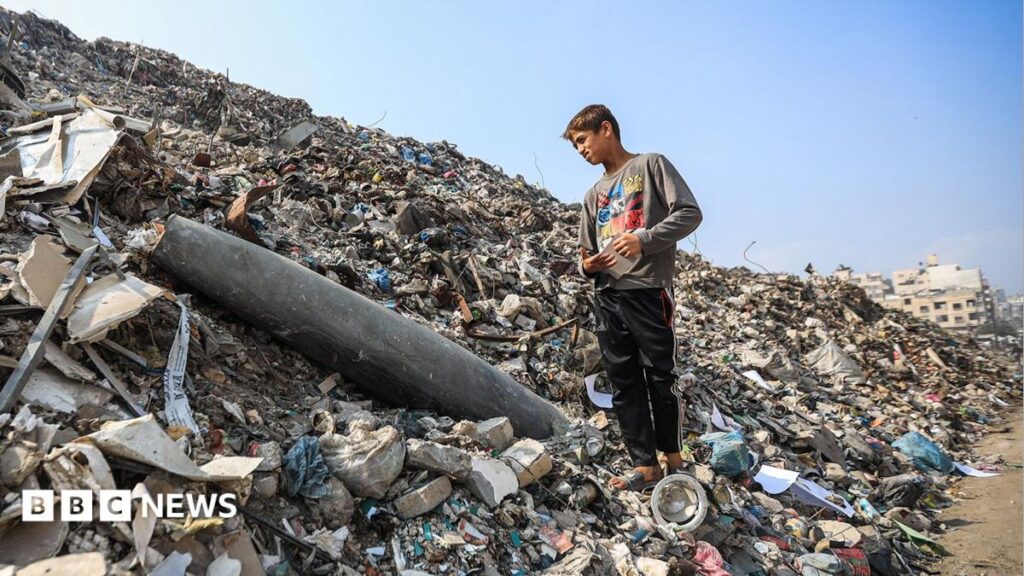
The UN estimates that Israeli forces dropped more than 200,000 tonnes of explosives on Gaza in almost two years (file photo)
Published3 hours ago
Gaza has been turned into "a toxic wasteland", with more than 99% of the Palestinian territory showing indicators of environmental contamination from Israeli military attacks, a new report from the non-profit organisation Oxfam says, external.
Heavy metals, explosive residues, and asbestos from destroyed buildings, dioxins and biological contaminants in the air, soil and water supply are threats to Palestinians now and potentially for decades to come, it says.
Oxfam International's executive director, Amitabh Behar, accuses Israel of "environmental war crimes" as part of an "ongoing genocide in Gaza."
"The destruction and contamination of Gaza will have fundamentally degraded the environmental conditions necessary for human safety and survival," he says.
Israel's government has been asked for its response to the report.
It has rejected genocide accusations in an ongoing case at the International Court of Justice as baseless and distorted. Israel maintains that its military campaign in Gaza is an act of self-defence against Hamas in response to the group's deadly attack on Israel on 7 October 2023, and that it takes steps to mitigate civilian harm.
The report says 99% of Gaza shows indicators of potential environmental contamination
Oxfam and the UK-based Conflict and Environment Observatory (CEOBS) used satellite imagery, remote sensing, spatial analysis and other open-source data to draw their conclusions in the most comprehensive report to date on the severe environmental impacts caused by three years of intense war in Gaza.
The report details how munitions used in Israel's intense bombardment, as well as the debris from destroyed buildings and infrastructure, all have an impact on the environment. In February, a UN special rapporteur stated that more than 200,000 tonnes of explosives were dropped on Gaza in almost two years – "the equivalent of the total energy of approximately 13 Hiroshima-type nuclear bombs".
Last year, the UN Environment Programme (UNEP) estimated that Israel's military operations destroying homes and infrastructure had generated more than 61 million tonnes of debris across the territory, with about 15% potentially carrying a high risk of contamination from hazardous materials.
"There are going to be chronic health impacts that are long term because a lot of these contaminants are persistent in the environment," Oxfam report author Lama Abdul Samad told the BBC.
She says that now and in future Gazans are likely to suffer from increased respiratory diseases, cancers, organ damage and a rise in birth defects and stillbirths.
Only a small fraction of the more than 60 million tonnes of debris in Gaza has been cleared
With all six wastewater treatment plants out of operation in Gaza, untreated sewage currently makes its way into groundwater and the Mediterranean Sea. The health impact has recently been exacerbated by heavy winter storms causing rainwater to mix with wastewater and flow through streets and tent sites housing displaced people.
Testing types and levels of contamination is often not possible because Gazan laboratories have been destroyed and there are Israeli restrictions on the entry of specialist testing equipment and scientists. The BBC has approached the Israeli military for comment.
UNEP said security concerns also prevented its expert staff from previously travelling to Gaza.
The Oxfam report calls for a full, independent environmental assessment to be carried out in Gaza to identify contamination risks ahead of a clean-up. It says special attention must be given to the protection of workers involved.
Recent winter storms caused rainwater to mix with wastewater and flow through streets and tent camps
Already, Gazan doctors have been reporting increased acute respiratory infections caused by dust and pollution from destroyed buildings and displaced people burning plastic, rags and cardboard to keep warm and cook food. Gastrointestinal diseases are linked to unsafe water and poor sanitation.
A Palestinian dermatologist, Dr Alaa Abu Hajar, told the BBC he had seen a five-fold increase in chronic skin diseases since the start of the war, putting this down to environmental pollution and overcrowded, unhygienic living conditions in tents and displacement camps.
"There are rodents, rubbish and sewage that's spread through the streets," he says. "Unfortunately, the age group most affected is children."
Dr Alaa Abu Hajar has seen a five-fold increase in chronic skin diseases since the start of the war
Farmers and those working in fishing say that pollution of the soil and sea mean they are unable to produce food that is safe.
"Sewage and wastewater are discharged into the sea without treatment and this is a great disaster," complains fisherman Abu al-Abed Sultan. "There is also rubble from destroyed houses that's dumped into the sea. When we lower our nets, we catch rubble and garbage. This harms the marine environment; the fish are affected and so are the fishermen."
At least 74,746 Palestinians have been killed since the start of the war in Gaza, according to the Hamas-run health ministry, whose figures are considered reliable by the UN. The UN says that humanitarian conditions remain dire.
Israel has conditioned large-scale Gaza reconstruction on the full disarmament of Hamas and other Palestinian armed groups. In July, Hamas accepted a plan put forward by the US-led Board of Peace to give up its weapons in exchange for an Israeli troop withdrawal. However, the Israeli government said the proposal was insufficient.
منبع: بی بی سی