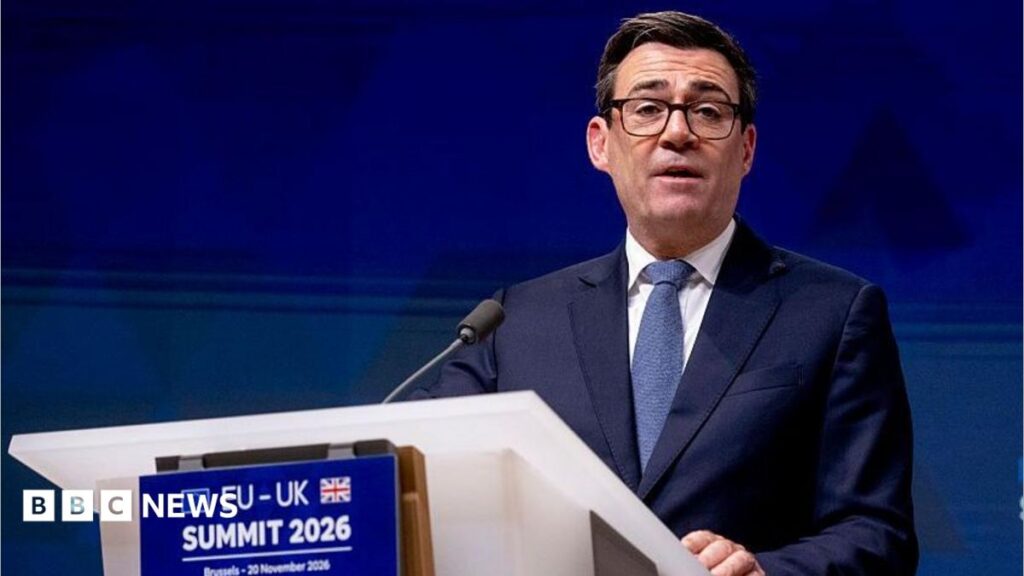
Andy Burnham agreed a deal with the EU in Brussels on Friday
Published48 minutes ago
The prime minister will tell Parliament on Monday the "landmark" deal struck with the EU means there is a "very real prospect" the next decade can be "much better" than the last one.
The deal is a "choice between a broken status quo or change", Andy Burnham will tell MPs.
He will also call it "the single biggest growth measure to be delivered in this parliament" – repeating his claim it could add £17bn to the British economy.
The PM described it on Friday as a "win-win" deal with the EU on British food exports, emissions trading and a youth experience scheme. But since then a host of politicians have criticised the plan, with one former prime minister urging him to "move on" from Brexit.
Burnham believes the agreement reached in Brussels "holds out the very real prospect that the next decade can be a much better one for Britain than the one we have just lived through".
"The ability to draw a line on a decade of drift and division is in our hands and I believe we should take it," he will say in his speech.
He will also paint the move as a choice "between easing pressure on the cost of living or allowing food prices to rise further" and "creating opportunities for young people or denying them".
He believes polling suggests the UK public "want closer ties" with the EU and the deal "delivers that".
But his announcement on Friday was greeted with a chorus of criticism from a number of opposing political figures.
Conservative Party leader Kemi Badenoch said the deal was unfair because UK farmers would now have to follow rules made by Brussels.
She questioned the Treasury's analysis, which Burnham said suggested the deal "will add up to 0.5%" to UK gross domestic product and he described it as a "£17bn boost to the British economy".
Badenoch accused him of having "plucked that figure out of the air" before saying "the only modelling I've seen that even talks about that figure says it's actually 0.0%".
Meanwhile Reform UK leader Farage called the deal a "very good day for the EU", before adding: "A good day to try and humiliate the one member state that actually had the courage to say, 'We don't need to be part of you, we can govern our own country'."
Farage, who was a leading figure in the 2016 campaign to get Britain out of the EU, added in a social media post: "Like every prime minister before him, Burnham is a total fraud. Only Reform will stop the endless betrayal of the British people."
Over the weekend former prime ministers including Theresa May, Sir Tony Blair and Rishi Sunak also criticised the EU-UK deal.
May, who presided over three years of Brexit negotiations during her premiership, said she was "aghast" by the deal and warned Andy Burnham should "move on".
Sir Tony, who was a prominent opponent of leaving the EU, told The Sunday Times Britain should only rejoin the EU if it reforms, and allows more innovation on technology.
Badenoch will use her speech at the Confederation of British Industry (CBI) annual conference on Monday to criticise Burnham's EU deal.
She will accuse the prime minister of securing a "terrible" deal and will say he should be "aiming a lot higher" in terms of driving growth.
Farage will tell the same conference that establishing closer ties with the EU would be a "disaster" for British businesses.
Rejoining the EU will hit the small firms that do not even trade with Europe with more red tape, more compliance costs, more Brussels rules they never asked for, he is expected to say.
On Friday, the PM said that over the coming months both sides will "seek to conduct an informal brainstorming process" to look at the options for the UK's "long-term relationship" with the EU.
He was also clear that the deal he struck was "probably the limit of what we can achieve in this Parliament, given what needs to be done to implement it".
He added: "But we want to inform the Parliament after this one, so that decisions can be taken about that long-term relationship."
منبع: بی بی سی