
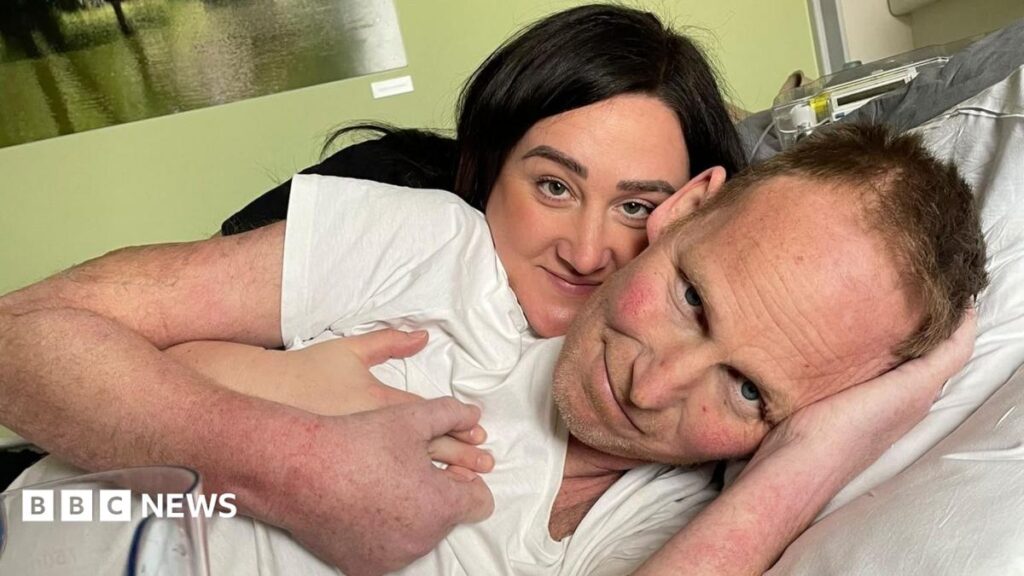
Lauren's husband Andy died from cancer in 2024
Published5 hours ago
Every room in Lauren's family home reminds her of her late husband.
A self-employed builder, Andy carried out much of the work on the property himself, helping create the house where the couple raised their four children.
Now, more than two years after his death from cancer, Lauren fears she may struggle to keep it.
The financial support that helped her cover mortgage payments and household bills has ended, leaving her facing uncertainty as she prepares to remortgage the property.
"I don't want to uproot my children," she said. "They've already been through too much the last two and a half years."
Lauren says Andy's biggest concern before he died was how the family would cope financially
Lauren, from Redditch, lost her husband in May 2024, just five months after he was diagnosed with terminal cancer at the age of 42.
The family's income fell by about 80% after his death.
She says bereavement support payments provided a lifeline while she adapted to life as the sole provider for her children.
Now those payments have ended, she faces an uncertain future.
"Will I get a mortgage? I don't know," she said.
Lauren said Andy had first begun suffering stomach complaints in December 2023, around the same time the family were looking into life insurance.
"By the time we really needed it, it was too late… he now had something that was pre-existing," she said.
Although doctors initially gave Andy a prognosis of 16 months, his condition deteriorated rapidly.
"He died a very scared man," Lauren said. "His biggest worry was how I was going to cope financially."
Lauren says she does not want to uproot her four children from the family home
As well as a lump sum payment of £3,500, the government provides financial support of up to £350 a month to bereaved spouses, though it is time-limited.
For recipients of Universal Credit like Lauren, the payments only last a year.
Before 2017, support known as Widowed Parent's Allowance was available until children reached the age of 18, but it was replaced by Bereavement Support Payment.
Lauren said the payments had helped cover mortgage costs, food and household bills after her husband's death.
Without them, she says she is struggling to bridge the gap.
"I just can't find that money," she said. "I can't work any more hours than I'm working."
She believes bereavement support should last longer, rise in line with inflation and be promoted more clearly.
"It feels like a secret benefit," she said.
A petition calling for changes to bereavement support is due to be debated by MPs
Lauren's experience has led her to join campaign group Widows Fight, which is calling for changes to the system.
Its petition, which attracted nearly 109,000 signatures, is due to be debated by MPs on Monday.
Campaigners want support to better reflect the financial pressures facing bereaved families, particularly those with dependent children.
For Lauren, however, the issue is less about politics than the practical reality of providing for her family while trying to preserve what her husband left behind.
A Department for Work and Pensions spokesperson said: "Losing a loved one is devastating and we understand the financial impact it can have on families.
"Bereavement Support Payment provides short-term financial support, with higher amounts paid for those with children.
"Further help with everyday living costs may be available through benefits such as Universal Credit which provide targeted, means-tested support to those in greatest need."
If you've been affected by the issues in this story, help and support is available via the BBC Action Line
منبع: بی بی سی