
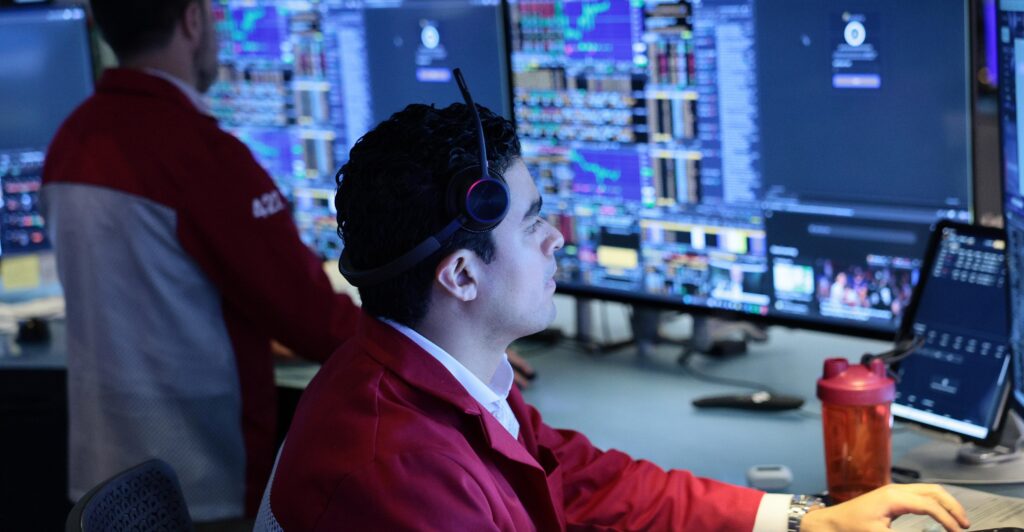
“We’ve got this,” Colette Kress, interim CEO of Nvidia, said Tuesday night as she closed out the embattled chip company’s third quarter earnings call. By Thursday, the company’s stock price was hovering at around $150 per share, a nearly 40 percent drop from its all-time high on October 6th, and wiping out a brief post-earnings pop on Tuesday night. Meanwhile, Wall Street was paying up for one of Nvidia’s biggest customers as Anthropic made its Nasdaq debut at $111.50 per share — 34 percent higher than expected.
Looking at the earnings report numbers alone, Nvidia had a blockbuster quarter. Q3 revenue more than doubled from the same period last year up to total $115.8 billion, driven by data center revenue that was up 110 percent and exceeding Wall Street expectations. Nearly $20 billion in revenue came from the highly anticipated Vera Rubin platform, which shipped during the quarter, becoming the “fastest product ramp in company history,” Kress told investors. “Our momentum is real,” Kress said.
“With the market-leading multiyear roadmap, supply agreements extending through to the end of the decade, and sustainable demand, we are well positioned to accelerate Nvidia’s leadership position.” But investors are still trying to reconcile Nvidia’s stellar recent financial performance and position as a central pillar in the AI economy with serious concerns over its future. The company’s stock has taken a stunning tumble in recent weeks.
Fueled first by a broader market sell-off of chip stocks amid concerns about the AI bubble, the stock took another blow following the resignation of former CEO Jensen Huang amid reports of extramarital affairs, including one with an alleged Chinese spy, according to US intelligence sources cited by The New York Times. Harvey Jones, Nvidia’s newly appointed chairman of the board, told investors on the call Tuesday that the company “does not intend to reinstate Jensen as CEO” and has already tapped an executive search firm to help find a replacement.
Huang, who cofounded Nvidia in 1993 and has led the company ever since — famously without a succession plan — has become essentially inseparable from it in the eyes of Wall Street and the media. But while Huang may not be ready to let go, posting on X this week that he’d be “honored” to be reinstated as CEO, Nvidia’s executive suite seems ready to move on. It has been a tumultuous two and a half weeks for Nvidia. On October 29th, The New York Times reported that US intelligence agencies believed Jensen Huang to be the target of a Chinese espionage plot.
The report centered on his “close relationship” with Alice Huang, a Chinese national and an executive at Megaspeed, a Singapore-based data center company and one of Nvidia’s clients. Nvidia initially contested the report, adding that Jensen Huang’s interactions with Alice Huang “are not unusual or unexpected.” Nvidia’s stock seemingly remained unaffected by the reports, at least at first. The share price closed at $213.66 on October 29th, down just 0.8 percent from the previous day.
(Julian Barnes, one of the reporters on the story, later commented, “I will confess I was kind of surprised that the world’s initial reaction to our October story was a bit muted.”) The stock closed at a 4 percent drop the next day as the entire Nasdaq fell 2.9 percent, the worst single-day decline since June. The stock continued to fall through Wednesday, November 4th, the day after the blue wave swept the midterms, stoking fears on Wall Street that the new class of Democratic governors in key states like Texas would slow down data center construction.
On Thursday, November 5th, Nvidia’s stock fell 9.2 percent, its largest single-day drop in at least a year. But chip stocks began to recover the next day, and by close on Friday, November 6th, Nvidia was back up 2.8 percent to a share price of $186.64. Then all hell broke loose. On Sunday, November 8th, Jensen Huang sent a company-wide memo to Nvidia staff in which he apologized for engaging in an extramarital affair.
The memo coincided with the opening of an independent investigation by Nvidia’s board into Huang’s alleged misconduct and whether company secrets or national security had been compromised. Huang said he would cooperate fully with the investigation. By the opening bell on Monday, November 9th, Nvidia shares had tumbled 7 percent and trading volume surged past its three-month average as investors reacted to the memo. After a brief rebound, the stock continued to oscillate the next day, as more details of Jensen Huang and Alice Huang’s relationship emerged.
By the time the market closed on Tuesday, November 10th, Nvidia shares were down to $168.89, nearly 10 percent below the closing price on the last day of 2025. The stock rebounded slightly on Wednesday, November 11th, as investors prepared for Nvidia’s third quarter earnings call, scheduled for the following Tuesday, November 17th.
By Wednesday night, however, shares had plunged yet again as media reports circulated that Nvidia’s board was considering ousting Huang, and other reports emerged detailing a second alleged affair, this time between Huang and an Nvidia employee. Nvidia announced Huang’s departure on the morning of Thursday, November 12th, sending the company’s shares falling nearly 14 percent at the open. It closed at just a 4.3 percent dip. The intraday low of $148.80 per share was its lowest price in a year.
On December 1st, Jensen Huang will appear before the House Foreign Affairs Committee, the Select Committee on the Chinese Communist Party, and the House Intelligence Committee for transcribed interviews. Nvidia’s general counsel will do the same on December 2nd. Retail investors have already seized the opportunity to buy the dip. In the first 30 minutes of trading on Thursday, November 12th, retail investors bought $111 million of Nvidia shares in the largest-ever first half-hour of opening for the stock, Bloomberg reported, citing Vanda Research.
They might be onto something. Nvidia’s average price target is $232.59, with the lowest estimate at $130 and the highest at $350, according to an analysis of analyst projections over the last three months by Google Finance. Nearly two-thirds of those analysts issued a “Buy” rating for Nvidia in the last three months. Of those, all 30 reiterated that rating post-earnings. The stock closed at $145.98 on Thursday, a new 52-week low. Then again, numbers are the core basis for stock market ratings, and numbers may not be Nvidia’s problem right now.
It’s everything else — the leadership vacuum, upcoming congressional testimony, regulatory uncertainty, broader questions about neocloud customer financing and sales to China — that will continue to impact the stock in the coming weeks.
منبع: ورگ