Published52 minutes ago
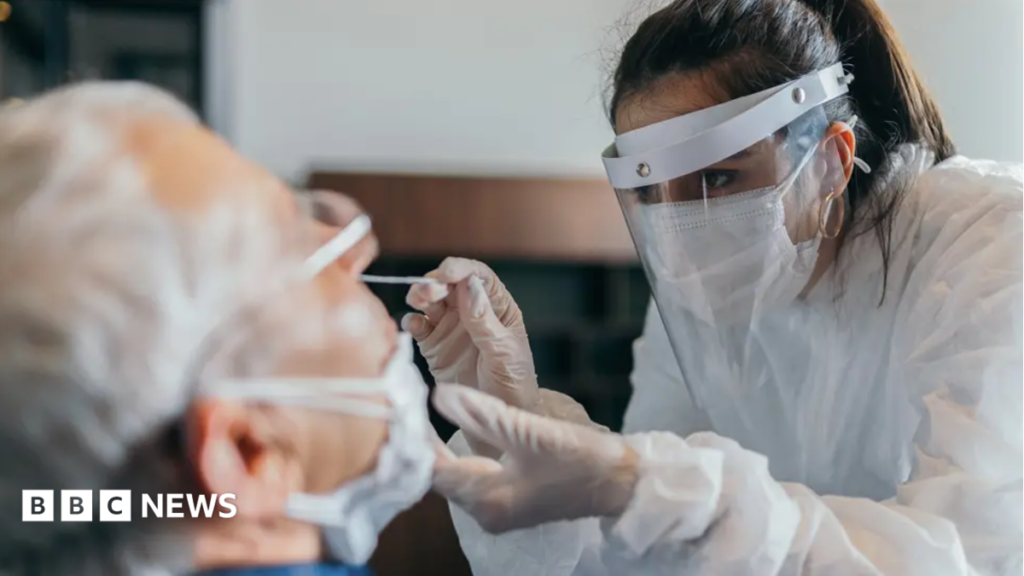
Early efforts to contain coronavirus "were doomed to fail" because the test, trace and isolate system in the UK could only handle a relatively small number of cases, the seventh report of the Covid inquiry says in a damning assessment.
Across 245 pages the inquiry looks at everything from border controls to how well contact tracing worked.
Here's what you need to know.
UK blind to how quickly Covid was spreading
The report said the virus was allowed to spread virtually unchecked in the first few months after community testing and contact tracing was abandoned in mid-March 2020, costing lives.
Ministers said this was because testing capacity was being overwhelmed.
NHS Test and Trace was launched two months later and eventually became one of the biggest testing services in the world per head of population.
In the end, more than £30bn was spent across the UK during the pandemic on testing, tracing and isolating.
Once established, it was effective.
But in those early months the four UK nations were "effectively blind" to how quickly Covid was spreading, the inquiry said.
It criticises the government for not having a robust test, trace and isolate system in place to start with, saying this, alongside other failures, meant harsher measures, including lockdown and school closures, were needed.
Inquiry chair Baroness Hallett said the UK should have been better prepared and learnt lessons from other countries that had experience of dealing with outbreaks of other infectious diseases, such as Sars.
Unlike the UK, places such as Hong Kong, South Korea, Singapore and Taiwan had established systems ready to go.
This was despite the fact the UK had run a series of simulation exercises in the years leading up to Covid.
It included Exercise Cygnus into a flu pandemic and Exercise Alice into Mers. Both identified problems relating to test, trace or isolation, which appear not to have been fully acted on.
The report also raises the question of whether the government could have made use of non-government testing facilities in hospitals, universities and the private sector from the start, instead of just relying on 12 government labs.
Many self-isolating 'felt forgotten'
When people in the UK were told to isolate, "many felt forgotten and let down by the lack of practical or financial support when trying to follow the rules", says the report.
In the early months of the pandemic, estimates suggested less than half of people were complying with the rules around isolating if infected.
Ministers and their advisers discussed this and fines of up to £10,000 were introduced for those who did not comply, which some experts have said was counter-productive.
Changes were made to allow people to claim statutory sick pay.
But it was not until September in England – and later in Scotland and Wales – that £500 financial payments were introduced to help those on low incomes comply.
More also needed to be done to provide practical support for things such as collecting medicines and shopping for food for those who did not have people to call on.
Suspending all flights from China to the UK in February 2020 could "have provided valuable additional time to prepare healthcare systems for the impact of the pandemic", said inquiry chair Baroness Hallett. That didn't happen.
The report says the UK lacked a clear strategy for implementing border control measures early in the pandemic, which left the country in an "extremely vulnerable position".
Although the closure and restriction of borders was noted as "immensely complex", the inquiry said that border control measures could serve as an important tool "to reassure the public and increase confidence."
By April 2020, 93% of countries had put measures in place, such as flight suspensions, border closures and travel restrictions, to control their international borders.
By contrast, the UK government only requested travellers arriving from high-risk areas to self-isolate for 14 days. The UK government implemented no further border control measures until June 2020.
The report says that border controls were a "critical gap in the UK's ability to limit the spread of the virus" and recommends that in the future "international border control measures should be in place at the earliest stages of a pandemic".
Smart phones and the 'pingdemic'
The inquiry report is more positive about the use of smartphone apps, saying digital tools can have a "significant impact on reducing the spread of infection".
It quotes a mathematical modelling study from the US which estimates that, when 75% of people used a contact tracing app in the pandemic, infections were reduced by at least 50%.
Three different apps were developed during Covid – one for England and Wales, another for Scotland and a third for Northern Ireland and the Republic of Ireland.
The inquiry says that took up "valuable time", and it recommends developing a UK-wide digital tool to use in any future outbreak.
It says it is "fundamentally important" that apps and digital tools are as accurate as possible – and people have confidence in them.
In the summer of 2021, as Covid restrictions were relaxed, around 7% of all UK adults were told to self-isolate over a seven-day period, something dubbed by the press as the "pingdemic".
It quotes Treasury estimates suggesting that may have reduced economic growth by as much as 0.3% that month.
منبع: بی بی سی