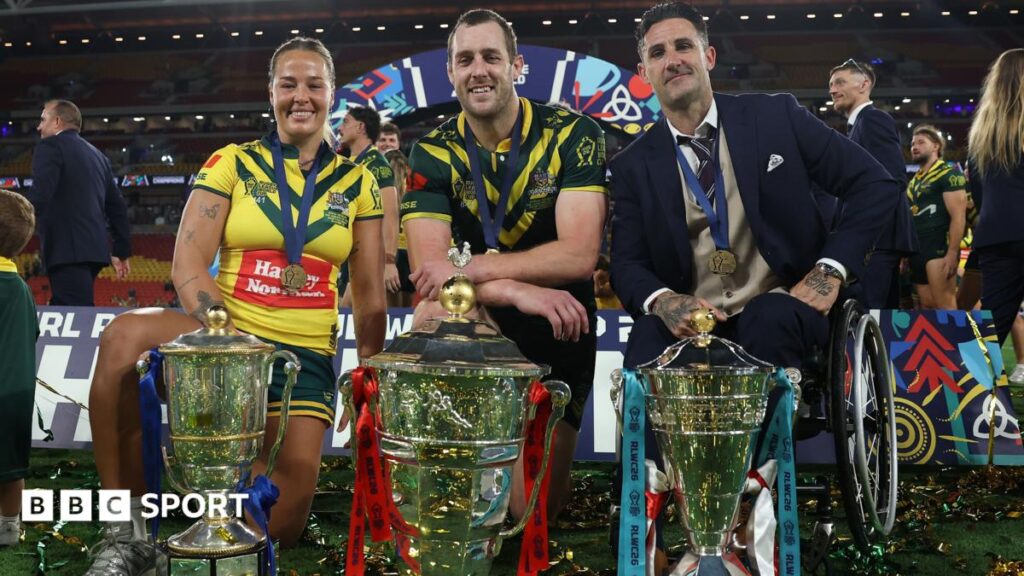
The winning captains: Australia's Isabelle Kelly, her men's counterpart Isaah Yeo and England wheelchair skipper Lewis King
Published6 hours ago
Has the 2026 Rugby League World Cup been a success or not?
It depends on who you listen to – and perhaps where in the world you are.
The men's, women's and wheelchair tournaments provided plenty of stories – from Kalyn Ponga's return from a broken arm in 23 days, to Jodie Cunningham's mangled ear,, external to the England wheelchair team's golden ladder, to the men's group format that caused widespread bafflement.
But was the World Cup a triumph? The northern and southern hemisphere perspectives provide contrasting answers.
For the fourth tournament running, Australia won the men's and women's titles, with New Zealand unable to deliver a twist in either final.
Tonga and Samoa brought vibrancy and passion – performing to a level that underlined why they are being elevated to Tier One status. The large Polynesian population in the USA – which will co-host the 2030 men's and women's World Cups – is likely to be key in spreading the rugby league word further around the world.
England's Wheelchair World Cup win, in a thunderous final against their old foes France, offset some of the disappointment felt when Brian McDermott's men and Stuart Barrow's women went home early.
And unlike when the game was emerging from post-pandemic constraints in 2022, the tournament has also worked financially by posting a profit.
"This whole tournament's been incredible," said Australia men's captain Isaah Yeo.
"Not just the fans here for New Zealand and Australia, but just everyone. I thought it was all outstanding.
"I think it's to date the most competitive and the best World Cup there's been. I think that's only going to continue to grow."
That sentiment has been endorsed repeatedly by Australian television broadcaster Channel Seven, which paid a reported A$12m (£6.1m) for exclusive domestic free-to-air coverage of the men's, women's and wheelchair tournaments.
Not everyone has been able to feel that positivity, though.
The decision to cut the men's tournament from 16 teams to 10 reduced the overall number of matches – and deprived teams such as Jamaica and Greece of a chance to build on the feelgood factor they provided as debutants in 2022.
That decision was made after Australia stepped in to stage the tournament, postponed for a year when scheduled hosts France pulled out for financial reasons.
For those who did get to the party this time, it has not always been an even contest. The disparity between the haves and have-nots has been significant.
While the Jillaroos and Kangaroos players will each receive equal payments of $40,000 (£20,500) for competing, Wales will reportedly spread a total of $15,000 (£7,689) across their women's and wheelchair teams., external
Viewer access to the World Cup has varied too. While Australia had free-to-air live television coverage, fans in the UK only got it for the wheelchair final, shown on BBC iPlayer. For all other games, they needed a Premier Sports subscription, which was also the only way to watch the tournament in North America.
With many matches staged at times when British and American viewers were likely to be in bed, it feels as if a chance to spread the game's gospel has been missed.
England become world champions for third time
Festival feel or competitive balance? Or neither?
Many of the players at this World Cup were Australia-based, as they play club rugby in either the NRL's men's competition or its Women's Premiership.
That helped the International Rugby League – the world governing body – to keep costs down, after it spent a vast sum transporting players from the southern hemisphere to England four years ago.
Paring back the men's competition also helped on the costs front, though another supposed benefit – cutting out the lopsided group-stage scorelines of four years ago – has not been evident.
France and the Cook Islands both conceded more than 180 points in the group stage, while scoring a combined 58.
Former England international Ryan Hall told BBC Radio 5 Live earlier this month that the men's World Cup had suffered for being slimmed down – with Scotland, Ireland, Italy and Wales also missing out.
"I don't think it is a World Cup," Hall said. "The essence of any World Cup in any sport is that it's a festival of the sport.
"Compare it to the football World Cup. Curacao were one of the 48 teams in the World Cup.
"I'm not saying rugby league could get 48 teams in the World Cup because that's not achievable, but [they could] certainly [have] more than 10.
"It's meant to be a festival and showcasing everyone of all levels of different countries who's eligible to play."
A format that contained no quarter-finals came in for widespread criticism from pundits, external before a ball was kicked.
The men's tournament featured one group of four and another of six. But two teams went through from both groups, and not everyone in the six-team pool played each other.
In the words of Castleford Tigers head coach Paul Rowley, the former England hooker: "It's trying to make a square with five sides." England captain George Williams, during the build-up, called the format "weird".
And England turned out to be the major losers. The draw left them with no margin for error as an underprepared and jet-lagged squad faced a dangerous Tonga side first up, and lost 30-12.
And ultimately, McDermott's side paid the price. Of the 26 teams across the three World Cups, only one side won two out of three group games and still failed to make the semi-finals: England's men.
Highlights: Australia beat New Zealand to win world cup for a fourth time in a row
Tonga fans streamed to stadiums in their numbers to support their team
An October and November tournament brings a different vibe depending on where you are. The last World Cup, in the UK, was staged as the temperatures dropped. This time around, it was held with co-hosts Australia, New Zealand and Papua New Guinea heading towards summer.
Fans have gone to games in T-shirts and shorts instead of thick winter garments – and tellingly, average footfall increased.
That is despite the fact that the capacity 52,000 crowd in Brisbane for finals night was lower than the 67,000 at Old Trafford four years ago.
In 2022, the men's group stage – spanning 24 games – was watched by an average crowd of 9,811, itself down on the 14,345 figure from 2013, when England and Wales played hosts.
This time around, the average crowd rose to 21,360. It probably helped that there were fewer group games. It certainly helped that every Australia match was well attended, and that there was strong backing for New Zealand, Samoa, Tonga and Papua New Guinea, who played twice in their capital Port Moresby.
Highlights: Australia beat New Zealand to win Women's Rugby League World Cup
Lessons have also clearly been learned from 2022's heavily criticised ticket pricing structure.
Instead of adults paying more than £20 to attend matches, it has been a more friendly A$19, which equates to £9.74 per ticket.
But while attendances at this year's tournament are up, there is still work to be done around the women's game.
The sight of more empty seats than supporters in grounds for a number of double-headers is hardly a good look for the organisers or broadcasters.
Jillaroos coach Jess Skinner notably raised the issue after her team defeated Samoa 40-0 in their Pool A opener at the home of Parramatta Eels on 16 October.
That match had followed Samoa's men thrashing France 78-4 – but in a stadium with a capacity of 30,000, many of the recorded 13,174 crowd had dispersed before the women's game got under way, with the stands appearing barely 20% full.
"Let's get around women in sport, right? All women in sport, particularly at this Rugby League World Cup," Skinner said. "We've got a lot of talented women across all the teams and the message would be to stay and support that.
"Something really cool's happening in this generation of sport, with our ladies, and you're going to miss history-making moments at this World Cup, no doubt."
Sadly for Skinner and her peerless team, it was a pattern that was repeated in Sunday's final, with the stands in Brisbane's Suncorp Stadium only filling as kick-off time for the men's game approached.
Australia's women cantered to a record fourth World Cup title against New Zealand
Northern hemisphere indifference?
Four years ago, the Rugby League World Cup was shown free-to-air in the UK by the BBC, with record-breaking viewing figures.
Almost 30 million people tuned in to watch the five-week extravaganza.
This time, the action has largely been behind a paywall. Premier Sports has shown all the World Cup matches live. The BBC showed the wheelchair final live, plus online highlights of selected games from all three tournaments.
In addition, it provided live radio coverage of all men's matches and some women's games, plus live text commentaries on selected games.
Rights were awarded by the International Rugby League – and not the Rugby Football League. Last month, IRL chair Troy Grant told the iPaper that it made the decision to go with Premier because the BBC did not offer enough money – though no other free-to-air broadcaster made a suitable offer either.
Former England international Jon Wilkin highlighted the issue during a BBC Radio 5 Live discussion at the start of this month, saying: "The World Cup should have been on the BBC.
"There is no doubt in my mind as a public service broadcaster, this had so many reasons to be a slam dunk home run to be free to air on the BBC. It had to be."
In response, a BBC spokesperson said: "We must make difficult choices to deliver the savings required while continuing to serve audiences as effectively as possible."
And therein lies a problem for the sport in the northern hemisphere, where more backing, more financial support and more coverage is needed to reverse the fortunes of the Super League and international teams largely bound to that competition.
The financial gulf to southern hemisphere's elite competitions was laid bare, when the NRL struck a record A$5.3bn (£2.78bn) television deal over seven years in July.
Super League's TV deal with Sky Sports, which expired at the end of 2026, was worth around £21.5m per year.
Even with the pending announcement of a deal to bring NRL investment into Super League, that particular playing field is a long way from being levelled.
And it means that when the next World Cup comes around, Australia can expect to be favourites to win the men's and women's tournaments again.
منبع: بی بی سی