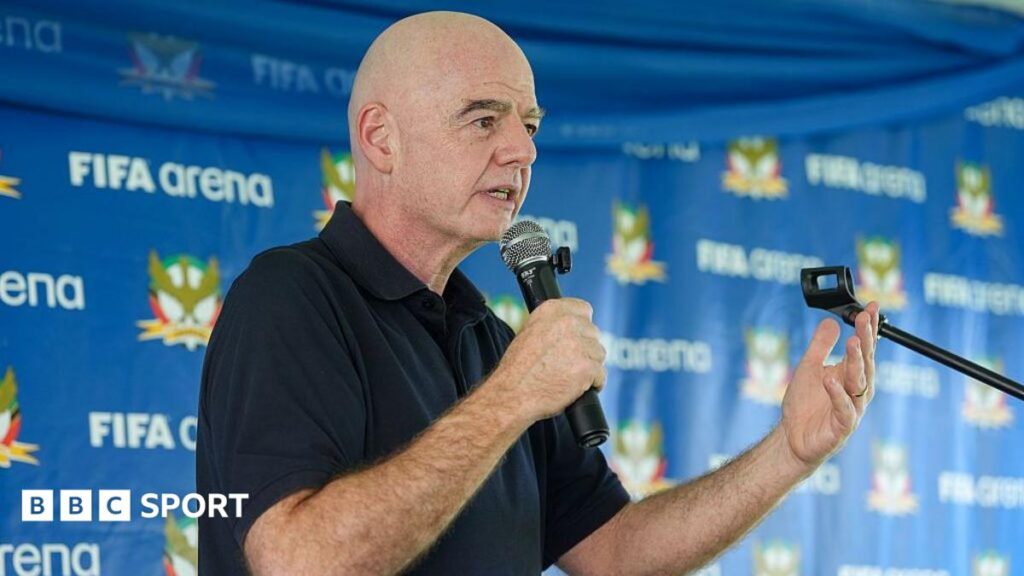
Gianni Infantino has been president of Fifa since 2016 and is standing for re-election for a third time
Published19 October 2026, 16:20 BST
European governing body Uefa has told Fifa it must release key documents and answer all questions relating to its governance and decision-making by a deadline of 2 November.
At the Fifa Council on Thursday, president Gianni Infantino apologised for his World Cup sell-off plan – but failed to offer a full explanation for how the proposal was devised.
In the letter seen by BBC Sport, Uefa general secretary Theodore Theodoridis said that world football's governing body had failed to address "a number of fundamental questions".
"Others remain unanswered, and the information and documentation requested have not been provided," it read.
The letter included eight pages of questions covering a number of issues, from the Fifa Forward Enterprise (FFE) private investment, to the Fifa Peace Prize and the controversial suspended ban given to USA striker Folarin Balogun at the World Cup.
"The withdrawal of FFE, the acknowledgement of mistakes and the announcement of 'potential governance reforms' do not answer how the relevant decisions were taken or why the Fifa Council was not involved at the appropriate stage," it continued.
"Any refusal to disclose information or documents should be justified individually, with a clear explanation of the specific grounds relied upon.
"These questions require answers now. They cannot be deferred until the next meeting of the Fifa Council – nor can future governance reforms substitute for scrutiny of decisions already taken and accountability for them."
Uefa did not outline what steps it intended to take should Fifa not meet the deadline.
The questions were first put to Infantino at the Fifa Council last week.
Football Association chair Debbie Hewitt – a Fifa vice-president – said afterwards that "if he doesn't answer those questions, he's not fit to be Fifa president".
Fifa has been approached for comment.
'Nothing has changed' – FA chair on Infantino
Uefa wants answers over Balogun suspension
Infantino has faced intense scrutiny over the case of Balogun, who avoided an immediate suspension after being sent off at the World Cup.
Balogun's ban was lifted by Fifa's disciplinary committee, after US President Donald Trump asked Infantino for the decision to be reviewed.
Fifa insisted the committee was independent but its legal committee is now reviewing a proposal to amend its disciplinary code, which would prevent a repeat, with an update due in December. Uefa has asked why this is necessary.
"President Trump publicly acknowledged having called the Fifa president to request a review of the Balogun disciplinary case. What exactly did he ask him to do, and what was his response?", Uefa has asked. "Would the case have been reviewed in the absence of his intervention?"
"Following that conversation, did the Fifa president or the Fifa secretary general communicate with anyone within Fifa, including members of the administration or the chair of the disciplinary committee, concerning the Balogun case? If so, could Fifa specify with whom, when and the nature of those communications?
"We also request all correspondence and other communications concerning the case between the chair of the disciplinary committee and the Fifa administration, including the Fifa president and Fifa's chief legal officer.
"Could Fifa provide the full written reasons for the decision in the Balogun case, including the information and evidence before the disciplinary committee?
"Who decided that the matter should be determined by a single member of the committee, on what basis…and what were the exceptional circumstances relied upon to justify the decision?"
Fifa faces question on FFE and funding to associations
Uefa has posed a great number of questions about FFE.
"When was the idea of FFE first explored, by whom and with what objective?" Uefa asked. "Who within Fifa authorised the development of the project, and which members of the Fifa administration were involved?
"What concrete measures will Fifa put in place to ensure that the shortcomings identified in the FFE process cannot occur again in the future?"
The relationship with Joshua Kushner's Thrive Capital was covered in detail, asking why an agreement granting exclusivity to the company was signed without prior consultation of the Fifa Council.
"Why was Thrive Capital selected as lead investor, without any competitive tendering process and under conditions of strict confidentiality, despite its links to the family of the recipient of the Fifa Peace Prize?" Uefa asked.
Kushner is the brother of Donald Trump's son-in-law, while the US president was awarded the Peace Prize.
Uefa also requested answer about the award of the Peace Prize, specifically who decided to establish it, for what purpose, and who decided that Trump should receive it.
When the FFE plan was revealed in the days following the World Cup final, Infantino told the 211 member associations (MAs) they would receive $40m (£30m) if they backed it. He then set a deadline of 19 September for federations to accept his plans if they wanted to access an initial $20m (£15m).
However, once the scheme was abandoned, Uefa and Concacaf called on Fifa to pay at least $10m (£7.5m) from its cash reserves to each of the MAs and, last week, Infantino agreed, proposing to increase the amount of money handed out for football development across the world by $3.4bn (£2.6bn).
The releasing of cash from its reserves will result in double the level of planned distribution funding for MAs from 2027 to 2030, with $25m (£19m) available per member association.
"Why was substantially increased funding for MAs presented in connection with FFE and external investment, rather than being financed directly from Fifa's own resources?" Uefa has asked.
"Given Fifa's strong financial position, why was it considered necessary to seek investment from private investors? What financial or strategic advantages would such an arrangement have offered compared with funding football development directly from Fifa's own resources, particularly in light of Fifa's subsequent proposal to do precisely that on a substantially increased scale?"
منبع: بی بی سی