As you dip into the valley on the way into Merthyr Tydfil, a new earthy-toned building dominates the view.
It's the new site of Saint Carlo Acutis Catholic School. With its rooftop science garden, solar panels and floor-to-ceiling windows, it's an impressive sight.
Excited staff and 940 pupils moved into the £50m complex at the start of September. But they did so just as the Welsh education system was being painted in a less positive light, with Wales once again ranking the worst of UK nations in global tests.
"It casts doubt over a system we're proud of and children that we're proud of," says Sarah Hopkins, who's been a headteacher here for eight years. She says it doesn't tell the full story but admits "it is disappointing".
Welsh parents are currently thinking about the next steps for their children, with application deadlines for secondary school places at the end of this month. That comes at a time when the test results pose difficult questions about why Wales has so clearly underperformed relative to its closest neighbours. And with Wales's devolved government now run by a party other than Labour for the first time ever, can the new Plaid Cymru administration do what it's promised and improve standards?
Sarah Hopkins started teaching in 1998 – a year before the Welsh Assembly, now the Senedd, took over responsibility for education in Wales from Westminster.
In that time she's had to navigate many system-wide and school changes.
The latest challenge has been managing the big move from the old mishmash of 1960s-built classrooms to the vast new building.
But buildings alone do not drive excellence, and the gap between Wales and the other UK countries is getting wider.
Sarah Hopkins describes the Wales Pisa results as "disappointing"
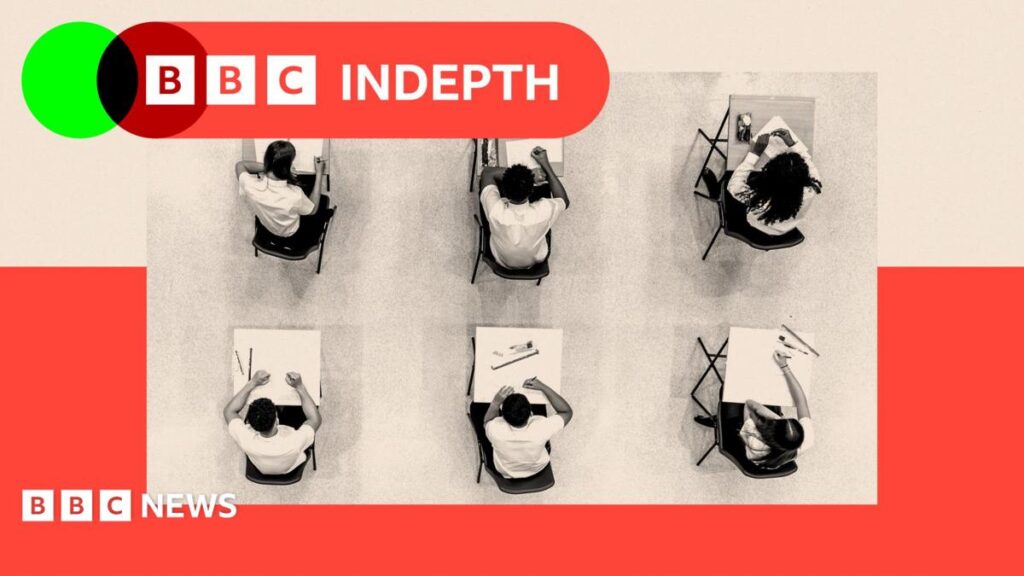
Pisa (Programme for International Student Assessment) measures teenagers' skills in reading, maths and science. Sat by a sample of 15-year-olds – 3,406 in Wales in 2025, including some in Sarah Hopkins' school – it provides a snapshot of how education systems are performing.
On the day results were published, Wales' education Minister, Anna Brychan, euphemistically said they were "not where we want them to be". Others called them catastrophic.
The graphs are stark.
Wales first took part in the tests in 2006. There have been upticks along the way. But when the pandemic affected scores across the board in 2022, Wales fell back furthest. And the gulf grew in the latest results.
The OECD, the global economic development body which runs Pisa, says that 20 points equates to roughly a year of learning. That would mean Welsh 15-year-olds are about two years behind England's in reading, science and maths. In reading, they also trail teenagers in Scotland and Northern Ireland by a year.
The tests alone don't capture everything schools do to support pupils, "whether that's a clean jumper, whether that's having a pen and a pencil" says Hopkins. And there are long-standing debates about the methodology of the tests. But nobody in Wales is pretending there's nothing to worry about.
Soon after the devolved administration was established, the Welsh Labour government of the early 2000s used its powers over education and other public services to go off on a different course to Tony Blair's Labour government at Westminster – creating what the then Welsh First Minister Rhodri Morgan called "clear, red water".
Secondary school league tables and standardised tests at seven, 11 and 14 (SATs) were scrapped. A new learning-through-play approach for the youngest pupils was an early flagship policy.
Poor Pisa results in 2010 brought about a drastic reappraisal. Plain speaking Education Minister Leighton Andrews called the results a "wake-up call" for a "complacent" system and introduced a new raft of reforms.
Alongside a literacy and numeracy drive, Andrews re-introduced accountability measures with annual reading and maths tests for seven-to-14 year olds, and a new school performance regime, called banding.
Pupils at Saint Carlo Acutis Catholic School are studying in a brand-new building
There were some parallels between the political styles of Andrews and the man in charge of England's schools system at the time, Conservative Michael Gove, who was on his own controversial education mission with an emphasis on high-stakes accountability. The two seemed to relish their occasional public spats over policy.
But policies introduced by Andrews lost their bite over time. The school banding system was changed and eventually dropped altogether during the pandemic. Tests later evolved into personalised assessments. And the focus moved to developing a new curriculum in Wales, something which Andrews recently said was a "distraction" from efforts to drive up standards.
Sir Nick Gibb, a former schools minister at Westminster who worked under Michael Gove, believes the main reason for Wales' Pisa woes is weak accountability.
He says "schools are spending billions of pounds of public money and they're not being held to account for the results that they produce".
He argues that focusing on the "science of learning" paid dividends with England's move up international education rankings. Primary schools in England were told they had to use a structured form of phonics to teach young children to read. This was reinforced with a phonics screening check for six-year-olds.
Sir Nick claims education standards in Wales and Scotland suffered because they didn't do the same.
In general, education ministers in England have been more likely to set direction for teachers, highlighted by the approach to phonics. In Wales, for the most part, the mantra has been to trust the profession. And though that freedom sounds good in theory, it has pitfalls.
It's the thinking at the heart of the new curriculum for Wales – dubbed the biggest reform to Welsh education in a generation.
There's widespread support for the core purposes of the curriculum which aim to create well-rounded young people with the skills to contribute to the economy and to society. But there's less confidence in the way it tries to go about achieving that.
The curriculum, which started being developed in 2014 and is only being fully rolled out this academic year, gives schools freedom to design their own curricula. In fact it's now "left almost completely up to schools what they should teach," says Lucy Crehan, an associate advisor on curriculum at Swansea University and education consultant.
Experts such as Crehan argue it's unlikely to improve standards and may make the situation worse by exacerbating inconsistency across schools.
Lucy Crehan is sceptical that the new curriculum will make things better
And many teachers, already overstretched and overwhelmed, have struggled.
"I think there does need to be more clarity for teachers, for schools on what actually it is they should be teaching and where it is they should be getting students to and by what point," Crehan says. She warns that it is the most disadvantaged pupils who could come off worst.
"This is categorically not teachers' fault. They have been let down by a system that has said, you're the professionals, off you go and sort out everything", says Crehan.
There has been a growing consensus about the need to provide teachers with extra support, which was acknowledged by the previous Labour government. Teaching unions warn the profession is being asked to introduce the biggest reform to Welsh education in a generation while still dealing with the fallout of the pandemic, including poor attendance and behaviour, as well as squeezed budgets.
In the meantime, the real test of the curriculum's impact on standards is yet to come. The next Pisa tests, planned for 2029, will be the first with the new curriculum fully in place.
'Nothing different in the water'
Apart from what's taught and how, there are other factors that could influence standards.
"There's nothing in the water in Wales that's different," says Nick Gibb. But, could the way the education system is structured play a part?
Unlike in England, in Wales there are no academies or free schools. Comprehensives, run by local authorities, are the norm. Former First Minister Lord Carwyn Jones believes that 22 councils is too many to run education effectively. He says failing to cut that number is his biggest regret in government.
Jones believes there is a "structural problem in Wales where the Welsh government sets policy…but doesn't deliver education", which is the job of local authorities.
Some councils oversee a handful of schools – including only four secondaries in some cases. "I just don't think you can have the right level of challenge or the right level of guidance if the local authority itself is very, very small," he says. Unless that's addressed, it's impossible "to provide the right level of support to improve our Pisa scores".
When Wales-based education economist Luke Sibieta compared GCSE results in areas such as Wrexham and Blaenau Gwent in Wales with the likes of similarly disadvantaged Gateshead and Salford in England, he found "disadvantaged pupils just perform worse in Wales than they do in England". The latest Pisa data showed the most disadvantaged pupils in England performed above the overall Welsh average in reading.
Wales' education Minister Anna Brychan says the Pisa results are not good
Reflecting on the early years of Welsh devolution, former Welsh government adviser Prof David Reynolds said ministers had been seeking change "by being nice to people rather than being nasty".
It's not been everyone's approach, but overall a lot of effort has been put into getting councils and unions on board with policies. Opinions vary about whether that's served pupils and staff well. Nick Gibb is one of those who argues that taking necessary steps to improve education standards means going "over the heads of unions" at times.
The question for Plaid
Taking the stage at Plaid Cymru's first conference in government, cabinet minister for Education Anna Brychan's assessment was more blunt than a month earlier, when the Pisa results came out. Speaking in Welsh, she called them "brawychus" – roughly translated as "terrible" or "shocking".
But so far she hasn't proposed wholesale changes to education. The minister has been at pains to emphasise that she's committed to the new curriculum. Even if it was practical to unpick it all, she's acknowledged there's little appetite for major upheaval. Instead, she's promising to review aspects of it and to set clearer steps for measuring how pupils are progressing.
Brychan's view is that a focus on literacy and numeracy has been "lost in the noise" of reforms. She's promised more clarity.
Phonics are more central to the plan and there will be more tracking of children's progress in primary school.
Wales' education system needs to be better at measuring itself, says Luke Sibieta, who is a research fellow at the Institute for Fiscal Studies. And without consistent benchmarks, it's not surprising that so much weight has been placed on Pisa's verdict. Sibieta makes the point that, looked at through a different lens, the downward trend in Wales' results is in line with "places like France, Germany, Italy, Spain" while England has been bucking the trend. That's little consolation for those involved in Welsh education.
Sarah Hopkins says her school has strived to build an effective curriculum due to professional pride and determination to make sure the "children get what they deserve", but she admits "there's no checks you're doing it properly".
Overall, she is optimistic that the new curriculum and efforts in schools to improve standards will bear fruit in better Pisa scores in future. "I think that there will be a time where Wales will lead the way," she says.
But some fear a generation of young people have been let down.
"It's not the be all and end all, how you do in Pisa," says Sibieta, "but if it means that young people are less highly skilled and less able to get good quality jobs later on in life, that has implications for all of us."
Graphic design: Jess Carr
Top image credit: Getty Images
BBC InDepth is the home on the website and app for the best analysis, with fresh perspectives that challenge assumptions and deep reporting on the biggest issues of the day. Emma Barnett and John Simpson bring their pick of the most thought-provoking deep reads and analysis, every Saturday. Sign up for the newsletter here
Are you personally affected by the issues raised in this story?
منبع: بی بی سی