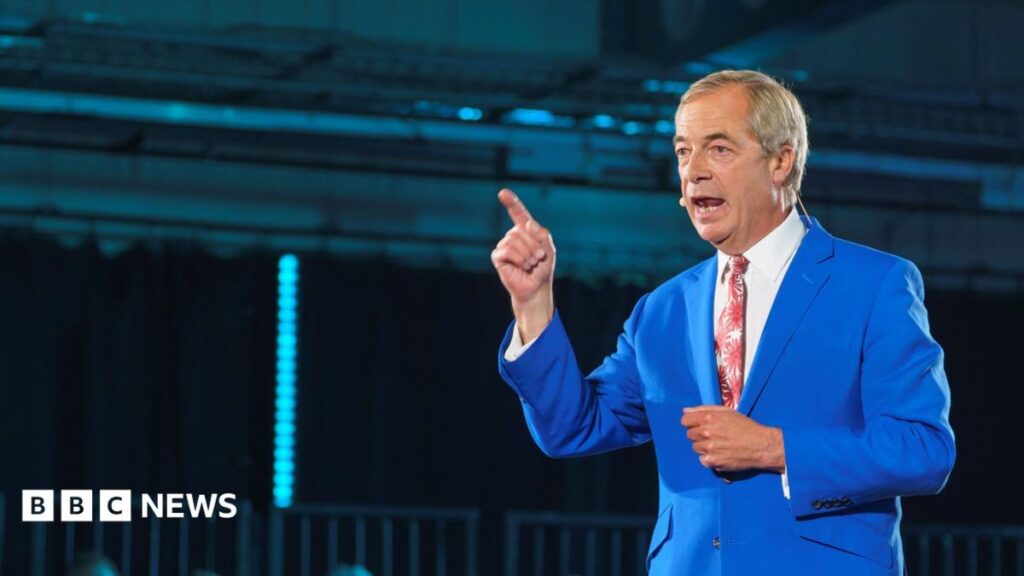
One of Reform UK's pledges for its first 100 days in power would be stopping small boat crossings, Nigel Farage has said
Published33 minutes ago
Reform UK has announced plans to close down the UK's asylum system for a full parliamentary term if it were to enter government.
The party said all new asylum applications would be rejected and existing applications voided, with all claimants marked for deportation, which Reform said would effectively suspend the asylum system.
Reform would scrap the asylum tribunal system, which hears asylum appeal cases, and claimants in more than 90,000 outstanding appeals would be deported.
It said no grants of humanitarian protection or refugee status would be made.
Labour chairperson Bridget Phillipson called the proposals a "clear sign of desperation and weakness".
"Running away from basic decency by entirely abandoning those escaping war and persecution might look to Reform like a way of winning a bidding war with other parties on the right, but the vast majority of British people will reject it as an assault on our common values," she said.
Conservative shadow home secretary Chris Philp said the proposals "largely copy" his party's policies, arguing: "Only the Conservatives have a serious and credible plan to fix our borders."
Liberal Democrat home affairs spokesperson Max Wilkinson said: "Reform and the Conservatives were the architects of the failed asylum system and now they will exploit it at every opportunity – including Farage's latest announcement."
Reform said it would pull the UK out of the European Convention on Human Rights (ECHR), repeal the Human Rights Act 1998 and disapply the 1951 Refugee Convention to prevent legal challenges to its plans.
Party leader Nigel Farage said the UK is "facing a national security emergency" and "we cannot accept more asylum seekers while we still have no idea how many people are in the country illegally and the threat they pose."
Home Office staff who currently oversee asylum claims would be "reprioritised to reviewing and overturning previous refugee grants", Reform added.
The party said it would attempt to pressure other countries into accepting those marked for deportation from the UK by using visa bans and tariffs on goods and services.
Pakistan, Somalia, Eritrea, Syria, Afghanistan and Sudan could be hit with visa bans under these measures.
If these policies are unsuccessful, Reform would "apply further sanctions, including banning a country's airlines from British airspace and their citizens from transit", the announcement added.
In "extreme cases" where no country is willing to take custody of a deportee or it is inappropriate to return someone to their home country, Reform said it would negotiate deals with third countries.
In April, Reform pledged an immediate review of all asylum claims from the last five years should the party win the next general election.
Around 400,000 people would be liable for deportation under the plans, which would target anybody granted asylum, overstaying a visa, or from a country deemed safe by a Reform-led government.
The party previously announced it would bar anyone arriving on a small boat, and suggested this could mean 600,000 deportations over five years.
Both Labour and the Conservatives have also pledged to make changes to the asylum system.
Phillipson said Farage is "casting around for more and more extreme policies" as he deals with questions about finances and rival party Restore Britain.
Phillipson said Labour is showing "we can control immigration and get numbers down with serious action, not by abandoning the asylum system altogether", adding the "right approach" is "not giving up or caving to the most extreme voices, but ensuring that the rules we have are properly enforced".
Between 1 January and 5 October 2026, a total of 20,478 people crossed the English Channel by small boat from France. This was down by 40% on the same period the previous year.
These crossings have become the most common way for people to be detected entering the UK illegally since 2020.
Nearly all those who arrive by small boat claim asylum. Under international law, this means they are allowed to stay in the country while their asylum application is considered.
Small boat arrivals made up 40% of asylum applications between July 2025 to June 2026.
Boats that arrived in the UK from 6 October 2025 to 5 October 2026 carried an average of 68 people. This has more than doubled since 2021.
Experts say overcrowding in boats makes crossings riskier. At least 84 people died while attempting to cross the Channel in 2024, according to the United Nations (UN).
When looking at the scale of small boats crossings, the number of these arrivals is about 5% of the size of total immigration into the UK from January 2025 to December 2025.
The government has pledged to “smash the gangs” behind these crossings in order to reduce the numbers.
People from Eritrea accounted for 18% of all arrivals from July 2025 to June 2026.
In the latest figures covering January 2025 to December 2025, at least 2,335 people who arrived by small boat were found to be potential victims of human trafficking or other forms of modern slavery, according to the Home Office.
Another 4,712 people were detected entering the UK without permission via other methods including hiding in vehicles, travelling on ferries or through airports from July 2025 to June 2026. This was down by 17% on the same period the previous year.
There are also individuals who arrive legally, for example via a work or study visa, and then overstay their limit.
The total number of people who live in the UK illegally after arriving legally is not known.
In March, Home Secretary Shabana Mahmood said any asylum seeker given refugee status will now only be offered temporary protection, reviewed every 30 months.
In September, she also reopened a scheme to resettle refugees in the UK, saying she hoped that offering "safe and legal" routes would deter small boat crossings.
The Home Office said the UK Resettlement Scheme (UKRS) would reopen immediately and expected that around 25% of arrivals would be Afghan women and girls and Palestinians.
Philp said Reform's plans mostly mirror Conservative policy from a year ago, including banning asylum claims by people who entered the country illegally, abolishing the immigration tribunal, ending Labour's resettlement routes, and leaving the ECHR.
The Tories previously said they would task officials with removing 750,000 illegal immigrants within five years, under Trump-style deportation plans.
Lib Dems spokesperson Wilkinson said the "UK can only restore order, control and fairness by joining the EU migration and asylum pact", which increases the number of irregular migrants returned to their home countries and spreads responsibility for asylum seekers across the EU.
منبع: بی بی سی