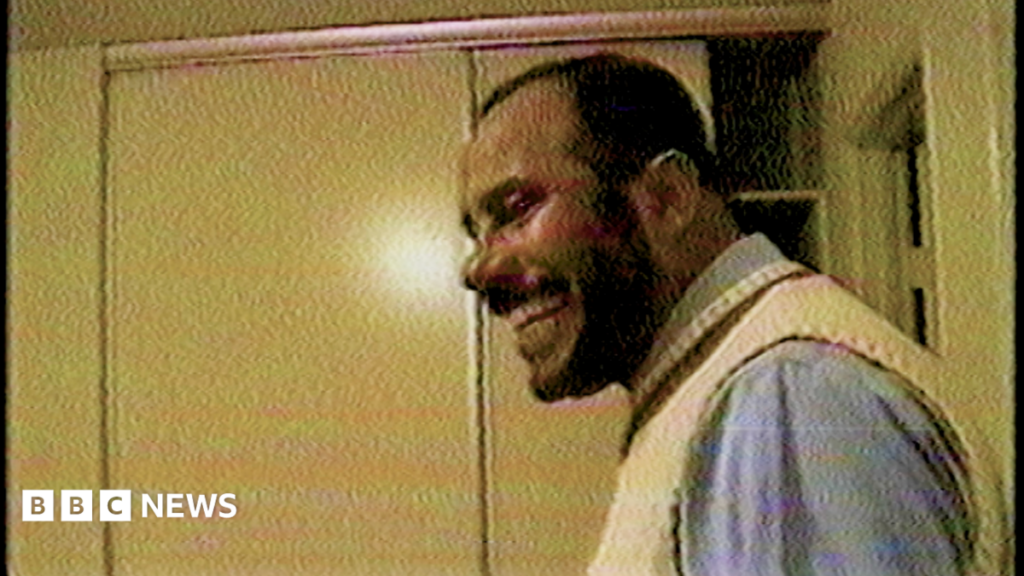
Saudi government employee, Omar al-Bayoumi, seen in February 2000
Published8 October 2026, 00:10 BST
The Court of Appeals in New York has heard arguments from both lawyers for families of 9/11 victims and the government of Saudi Arabia as it decides whether the families' long-running legal case against the Middle Eastern country can move to trial.
Almost 3,000 people were killed on 11 September 2001 after hijackers seized four US passenger jets and crashed them into the World Trade Center in New York, the Pentagon, and a Pennsylvania field, following resistance from passengers.
The families allege that a Saudi government employee, Omar al-Bayoumi, knowingly supported two of the hijackers and that he was working with a network of officials linked to the Saudi Ministry of Islamic Affairs.
Thousands of people were killed on 11 September 2001 after hijackers seized US passenger jets and crashed them into two New York skyscrapers
Bayoumi, who is now retired from government work, has denied knowing the two men were hijackers or that he had any involvement in 9/11, while Saudi Arabia has said that any allegation that it or its officials are complicit in 9/11 is categorically false.
The Kingdom has argued that, as a foreign sovereign state, it has immunity from prosecution in US courts.
The families, who first filed the lawsuit in 2002, spent several years lobbying US Congress to pass an amendment to the foreign sovereign immunity law to allow the case to go ahead.
In 2016, Congress passed the Justice Against Sponsors of Terrorism Act (JASTA), which allows civil claims against a foreign state or official for injuries, death, or damages from an act of international terrorism.
In August 2025, the Manhattan District Court ruled that the 9/11 families had presented enough evidence to meet the terms of the act and the case was allowed to proceed towards a trial.
Saudi Arabia on Wednesday asked the Court of Appeals to reverse that decision.
Counsel Gregory Rapawy argued core issues of fact – including the central question of the nature of Bayoumi's employment by the Saudi state – had not been decided and needed to be done so before the country could be stripped of immunity.
9/11 families' lawyer Gavin Simpson argued that the District Court had already found that Bayoumi's actions "were not just acts of a good Samaritan or an innocent participant".
"He was, in fact, following Saudi Arabia's instructions when assisting the hijackers," said Simpson, and that these were points that Saudi Arabia had "failed to rebut."
One option the judges seemed to wrestle with was whether to send the case back to the district court to make more concrete findings, which could involve taking testimony from live witnesses.
Asked by Judge Guido Calabresi which witnesses Saudi Arabia could call in that eventuality, Rapawy suggested that if the issue ultimately came down to Bayoumi's credibility, "we would have to see" if he could be called to testify.
As he drew the hearing to a close, Judge William Nardini said "it's a difficult case, and we will take it under advisement", meaning that the panel would issue a ruling at a future date.
Speaking outside the courthouse, Terry Strada, whose husband Tom was killed in the World Trade Center, told the BBC she felt positive about the hearing.
"25 years is an extraordinary time to go without accountability and justice for the murder of your loved one. What we hope is that the judges will uphold [District Court] Judge Daniels' decision and move to a trial."
منبع: بی بی سی