
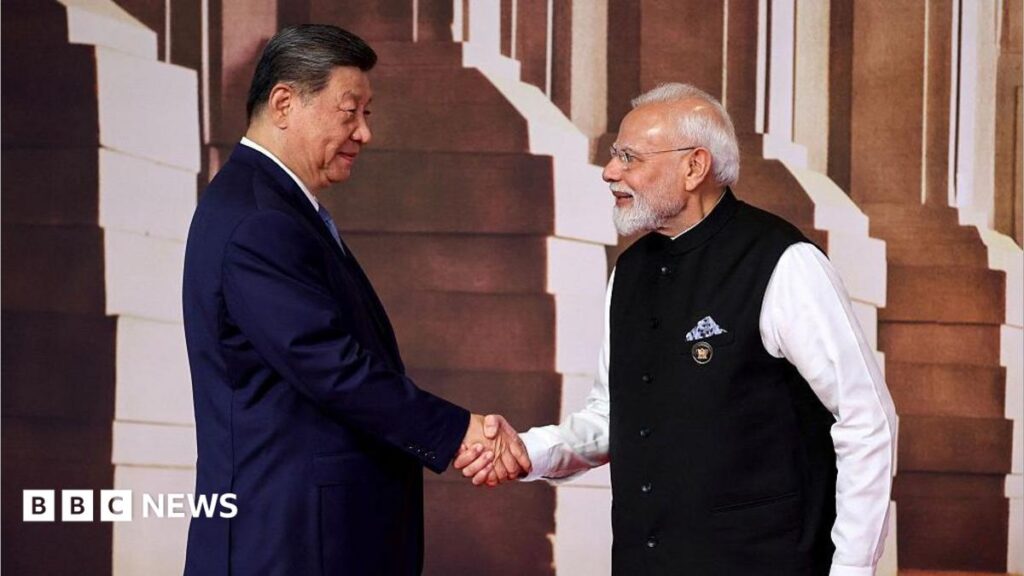
Xi and Modi have vowed to address growing trade imbalances
Published5 October 2026, 02:42 BST
Take a walk into an Indian toy shop and as well as picking up a new favourite plaything for a child, you might just get an insight into how the nation is battling for a better economic relationship with its all-powerful neighbour China.
Six years ago, in an attempt to push local manufacturing and keep substandard toys out of its market, India raised tariffs on imported toys from 20% to 60% and eventually to 70%.
Retailers were up in arms and said that domestic firms could never match the foreign-made stuff. But the combination of higher customs duties and quality control standards worked.
Indian imports of toys fell by a third from nearly $300m (£227m) in 2020 to $100m this year, while exports rose from around $129m to $200m in the same period. Moreover, the country was able to drastically reduce its dependence on China, which held a 70% share of the local toy market.
The sector stands out as a rare exception in India's otherwise unsuccessful attempts to rebalance an increasingly lopsided trading relationship with its larger neighbour, which some experts say, is now among the most asymmetric in the world.
Even as diplomatic ties between the two countries completely broke down following the Galwan Valley clashes in 2020 and Delhi announced a slew of anti-dumping duties and a ban on Chinese apps such as Tik Tok, its trade deficit with Beijing has only ballooned – from $44bn in 2020 to an eye-popping $112bn this year.
"India's economic dependence on China continued to deepen while political, security, and investment ties were at their lowest point," Kevin Zongzhe Li, a Washington-based Fellow at the Asia Society Policy Institute's Centre for China Analysis, told the BBC.
More worryingly, exports to China remained below pre-pandemic level even as imports doubled in this period.
"China now supplies over 30% of India's industrial imports, and India depends on it for more than 100 critical products. And the imbalance is worsening," says Ajay Srivastava of the Delhi-based Global Trade and Research Initiative (GTRI).
If the rapid pace of imports continues, bilateral deficit could jump to $134bn, giving Beijing even more leverage over Indian industry, according to Srivastava.
Anti-China sentiment hit a fever pitch post border skirmishes in 2020, but relations have now thawed
On the sidelines of the Brics summit in Delhi in September, amid a deepening thaw between the Asian giants, Prime Minister Narendra Modi and Chinese President Xi Jinping vowed to address, external these "structural trade imbalances and supply chain issues".
But given how deeply entrenched Chinese imports have become to India's industrial economy, this will be a formidable task for Delhi, experts told the BBC.
That's primarily because India depends on China to not merely consume end-products, but increasingly to produce industrial goods.
To be true, India has reduced its reliance on imports of finished goods such as smartphones and solar equipment, and now produces more than a quarter of the world's iPhones.
"Yet, production remains largely assembly-based and depends heavily on imported components, particularly from China," says Srivastava.
It's the same story with industrial machinery, battery inputs, chemicals, solar cells, and manufacturing equipment.
Electrical machinery and electronics alone account for 36% of imports, followed by machinery and mechanical appliances at 21.7%, while organic chemicals and plastics also have a significant share, according to the Observer Research Foundation (ORF) think tank.
"Their interruption would not merely affect consumption; it would disrupt production itself," according to Soumya Bhowmik, a Fellow at ORF's Centre for New Economic Diplomacy, who argues that this reflects India's difficulty in substituting Chinese inputs with local production.
Besides a growing reliance on inputs and raw material, Chinese imports to India are also being propelled by other macroeconomic trends.
China has huge excess capacity in sectors from steel to solar panels and electric vehicles, while its slowing economy cannot absorb the output.
Manufacturers are therefore increasingly turning to overseas markets, selling goods cheaply. China's trade surplus is expected to top $1tn for a second straight year.
A lot of these goods are coming to Indian shores because it is rapidly expanding manufacturing across segments of the economy, but also as "Western markets impose tariffs and other restrictions", says Srivastava.
India has reduced smartphone imports but depends heavily on China for components
On the other hand, lack of access to the Chinese market remains a major challenge for Indian companies.
"Indian products face a variety of tariff and non-tariff hurdles in China that make it difficult to scale exports," says Li.
"If normalisation [of ties] continues without a serious push for reciprocal market access, India risks a situation where the political relationship improves but the economic dependency stays the same."
The long term solution to both reducing avoidable imports and improving exports performance will be to strengthen manufacturing, says Srivastava.
But that requires sector-specific industrial policy and stronger fundamentals – affordable power and credit, efficient logistics and stable regulations – areas where India still falls short.
India has also recently softened foreign direct investment rules, which could open the door to Chinese companies wanting to expand Indian investments. But these too will need careful vetting, he adds.
"Investment that merely expands distribution networks or assembles products using Chinese parts could increase imports and deepen dependence. Approvals should therefore prioritise technology transfer, local value addition, domestic component production and exports from India."
More immediately, India could focus on targeting higher exports to China in specific sectors to reduce its trade asymmetry, says Li. Sectors like pharmaceuticals could be a natural fit with China's population aging and healthcare costs rising.
"But narrowing a $112bn deficit won't come from finding niche export sectors alone," he adds.
"The key question is whether Beijing is ready and willing to make concessions on market access as part of the broader normalisation. Alternatively, India will need to find its own leverage to force that conversation."
منبع: بی بی سی