
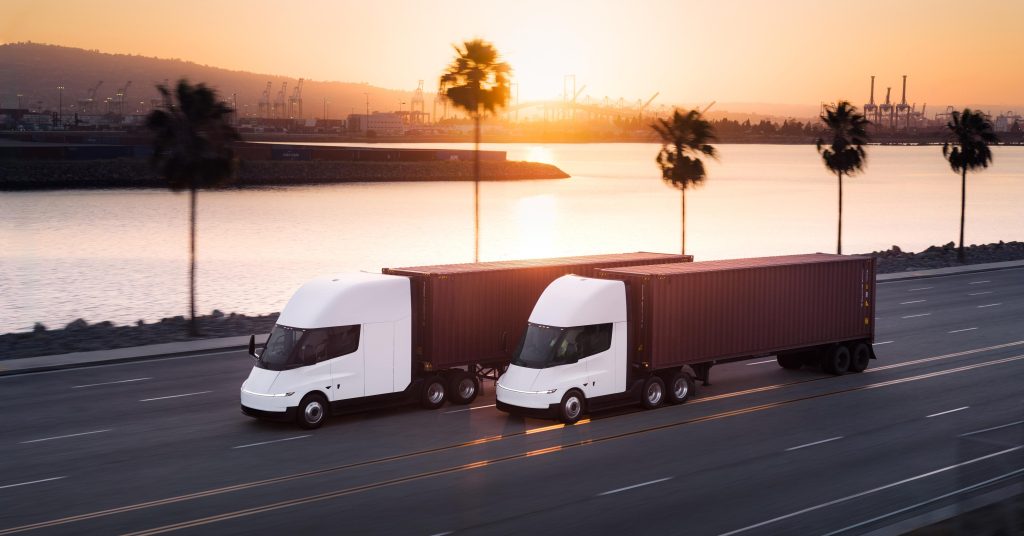
Remember the Tesla Semi? The long-gestating, heavy-duty truck first introduced in concept form in 2017 is finally in volume production as of April 2026 — nearly a decade after its initial introduction. On Thursday evening, the company held yet another event for the Semi to demonstrate to customers and investors that the long wait was finally over. The event was held at Tesla’s new Semi factory next to Gigafactory Nevada, where the company says it can build 50,000 trucks a year, or 1,000 per week.
The purpose was to announce a raft of new (and old) customers for the Semi, including PepsiCo, US Foods, DHL, WattEV, ABF, Einride, IMC, and OK Produce. (Most of these names were leaked ahead of the event by a YouTuber flying a drone over the company’s facility in Sparks, Nevada.) First deliveries of the truck started this week.
[Image: https://platform.theverge.com/wp-content/uploads/sites/2/2026/09/Semi_79.jpg?quality=90&strip=all] [Image: https://platform.theverge.com/wp-content/uploads/sites/2/2026/09/Semi_80.jpg?quality=90&strip=all] [Image: https://platform.theverge.com/wp-content/uploads/sites/2/2026/09/Semi_81.jpg?quality=90&strip=all] [Image: https://platform.theverge.com/wp-content/uploads/sites/2/2026/09/Semi_82.jpg?quality=90&strip=all] [Image: https://platform.theverge.com/wp-content/uploads/sites/2/2026/09/Semi_83.jpg?quality=90&strip=all] [Image: https://platform.theverge.com/wp-content/uploads/sites/2/2026/09/Semi_84.jpg?quality=90&strip=all] [Image: https://platform.theverge.com/wp-content/uploads/sites/2/2026/09/Semi_85.jpg?quality=90&strip=all] [Image: https://platform.theverge.com/wp-content/uploads/sites/2/2026/09/Semi_86.jpg?quality=90&strip=all] [Image: https://platform.theverge.com/wp-content/uploads/sites/2/2026/09/Semi_87.jpg?quality=90&strip=all] But there were still a lot of missing details that could have helped explain why the wait was so long, and where the Semi goes from here.
Tesla didn’t reveal order numbers, nor did it update the price of the Semi — which is rumored to be $290,000 for the long range version. In short, like many Tesla events these days, this one was lacking in some key updates. The trucks were supposed to go into production in 2019 but were delayed for a variety of reasons, including the covid pandemic and a global parts shortage. Tesla delivered a handful of trucks to PepsiCo in 2022, but those units were essentially built by hand on a pilot line.
Back in 2017, the company advertised a starting price of $150,000 for the 300-mile version and $180,000 for the 500-mile one. Tesla never officially updated those prices until today, but Eletrek reported earlier this year that Tesla was quoting customers $290,000 for the 500-mile range version. Tesla spent the last three years refining the Semi’s design, shaving nearly 1,000 lbs off the weight, and building out a dedicated factory next to its Gigafactory in Sparks.
The company revealed the final production design in February 2026, confirming two trims: a Standard Range truck with 325 miles at full 82,000-lb gross combination weight, and a Long Range version with 500 miles of range. In April, Tesla announced that the first Semi had rolled off the line at the new facility, kicking off volume production of the long-delayed truck.
Tesla CEO Elon Musk wasn’t at the event — he was in Washington, DC, attending a state dinner with President Trump and Chinese President Xi — but in a pre-recorded message, he praised the Semi as “the funnest truck to drive.” “This is really going to be a revolutionary truck,” Musk said, “that is capable of carrying the heaviest loads over very long distances. With ease of recharge, Megacharger that’s capable of a megawatt of power.
This is really going to be a phenomenal truck.” [Media: https://twitter.com/tesla_semi/status/2103289460767203424] Battery and engineering Much of the event was devoted to the hardware and engineering that went into the truck. Tesla’s Director of Semi Truck Engineering Dan Priestley emphasized that the 500 mile figure comes from fully loaded trucks rather than tests with a diminishing payload. Tesla Vice President of Engineering Lars Moravy said a Semi carrying a lighter load of around 60,000 pounds could potentially reach about 600 miles.
The lower-range truck will have lower mass and be suited to a variety of applications, giving the company multiple Semi configurations rather than relying solely on the long-range version. Tesla claims the Semi, with its lower energy cost and far fewer parts to maintain, is cheaper to run than diesel. That’s not hard to believe with diesel prices having hit historic record highs, soaring past $6.50 a gallon in the US — nearly double what it cost a year ago.
Tesla says the fully loaded truck now consumes about 1,700 Wh/mile, compared with an original target of 2,000 Wh/mile. The efficiency gains allow Tesla to use a smaller, lighter and cheaper battery while retaining the same range. The Semi is using Tesla’s in-house 4680 battery cells, replacing the purchased 2170 cells used in previous test versions. Tesla says the change, combined with vehicle-efficiency improvements, produces a lower-mass, lower-kWh battery without sacrificing range.
The company has also substantially redesigned the powertrain and drive axle since the Semi’s initial reveal. The truck gets a new steel-caged rotor instead of the earlier carbon-fiber-sleeved rotor, a bar-wound stator shared with Cybertruck, and a redesigned drive axle that is about 80 kilograms lighter. Tesla also eliminated the three separate oils used in the original drive axle, leaving no oil in the hub and one common oil for the motor and gearbox, which Moravy says should last more than 250,000 miles.
The hydraulic steering has been replaced by redundant electric power steering that Tesla says provides much greater precision and response. Meanwhile, the truck’s increased wheel cut gives it nearly the turning radius of a Model Y. Tesla specifically designed the system to make tight urban and loading-dock maneuvers easier, Priestley said. The Semi also shares parts with the newly road-worthy Cybercab, using the same indirect thermal system, including pumps, compressors, and heat exchangers, as the autonomous vehicle.
Tesla says the system eliminates long refrigerant lines running to the front of the vehicle and can move heat between the cabin, battery and drive unit to improve efficiency.
[Image: https://platform.theverge.com/wp-content/uploads/sites/2/2026/09/Semi_89.jpg?quality=90&strip=all] [Image: https://platform.theverge.com/wp-content/uploads/sites/2/2026/09/Semi_90.jpg?quality=90&strip=all] [Image: https://platform.theverge.com/wp-content/uploads/sites/2/2026/09/Semi_91.jpg?quality=90&strip=all] [Image: https://platform.theverge.com/wp-content/uploads/sites/2/2026/09/Semi_92.jpg?quality=90&strip=all] [Image: https://platform.theverge.com/wp-content/uploads/sites/2/2026/09/Semi_93.jpg?quality=90&strip=all] [Image: https://platform.theverge.com/wp-content/uploads/sites/2/2026/09/Semi_94.jpg?quality=90&strip=all] [Image: https://platform.theverge.com/wp-content/uploads/sites/2/2026/09/Semi_96.jpg?quality=90&strip=all] [Image: https://platform.theverge.com/wp-content/uploads/sites/2/2026/09/Semi_98.jpg?quality=90&strip=all] Charging and uptime Over the past year, Tesla has been building up a customer list for the Semi, including PepsiCo, DHL, ABF Freight, and others.
Autonomous trucking startup Einride announced a 500-truck order in August, while IMC Logistics said it would buy 50 Semis for California drayage earlier this week. And on Monday, Tesla was selected by “a coalition of the world’s largest cargo-owning shippers” to supply 2,500 trucks for zero-emission freight shipping in California. Now the challenge will meeting this demand by getting trucks to customers — and quickly.
Some of these freight operators have been waiting for years for Tesla to deliver its promised electric trucks, and any more delay will just further damage the company’s reputation. "“This is really going to be a revolutionary truck.”" – Elon Musk Charging will be another challenge, as the Semi requires higher power levels in order to fill its enormous 822 kWh battery pack. Tesla has begun to build out its Megacharger system that can deliver up to 1.2 Megawatts of power per stall.
Tesla says it will have more than 30 Semi charging stations representing over 200 megawatt-capable posts by the end of the year, while also supporting customer-installed overnight charging. During the event, Priestley and Moravy kept checking in on a Semi charging at one of the new Megawatt chargers, demonstrating a 3-60 percent charge in about 30 minutes. Tesla is positioning the Semi as an integrated fleet product, not just an electric truck.
The company says its existing fleet has demonstrated more than 98 percent uptime, compared to an average 90-95 percent for diesel-powered class 8 trucks across the industry. Tesla is also building out a dedicated Semi service, mobile service, remote diagnostics and OTA updates around the truck. The executives demonstrated a number of innovations they said would make for a better driving experience, including driver profiles that follow drivers from truck to truck and range estimates dynamically accounting for changing payloads.
While Tesla didn’t reveal order numbers or starting prices, Musk did say that the “waiting list is significant” and encouraged people to place orders. The company repeatedly emphasized how the Semi is able to achieve a lower total cost of ownership versus diesel, including lower energy costs, reduced maintenance, and less exposure to diesel-price volatility. “You know, volatility in the oil market and the diesel market goes up and down,” Moravy said. “But typically, we’ve seen in the history of the last 20 years, electricity is pretty flat.
And wouldn’t it be great to have a flat cost in your shipping rates?” Images by Tesla
منبع: ورگ