
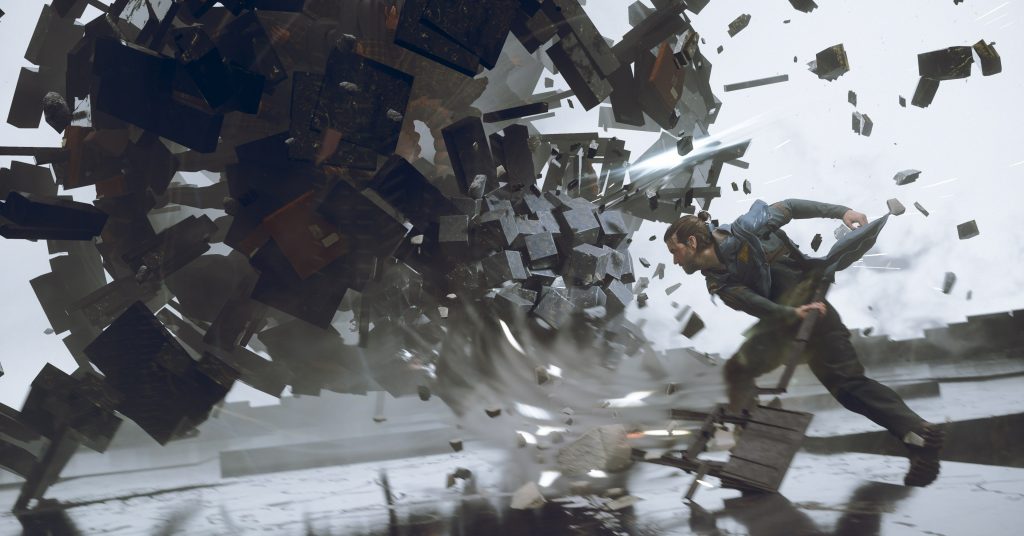
Video games have given us plenty of ways to traverse huge open worlds, but none have felt quite as oddly exhilarating as manipulating gravity in Control Resonant’s twisted version of New York City. It’s a game that lets you flip, twist, and fly through the air, while exploring settings that look ripped out of Inception. It’s as if you mashed up the meta storytelling of House of Leaves with the inventive platforming of Super Mario Galaxy and somehow turned it into a coherent experience.
That strange combination is just the latest example of developer Remedy making games like nobody else out there. Resonant is a sequel to 2019’s Control — though the two games are designed to be played in any order — and is centered on a supernatural government agency known as the Federal Bureau of Control, or FBC. The original game followed new FBC director Jesse Faden as she tried to fight off a paranormal force known as the Hiss, which was invading the Oldest House, the FBC’s labyrinth headquarters.
The sequel puts you in the role of her brother Dylan as the Hiss and other interdimensional threats start taking over Manhattan. A few things have changed in the sequel aside from the setting and protagonist. The big one is that Resonant is set in a relatively large open world, as opposed to the confines of the Oldest House. It’s a place that has been warped by the invading forces; buildings twist and bend in impossible ways, and sometimes gravity doesn’t behave as it should.
The other major change is that while the original Control was mostly a shooter, Resonant is melee-focused, as Dylan wields a shapeshifting weapon that can mimic things like a whip or a hammer. [Media: https://www.youtube.com/watch?v=SqvAvOAd1VA] Initially, Resonant plays much like a traditional open-world action game. Dylan has two main goals: to eradicate the forces invading New York, and to find Jesse, who has been missing since the events of the first Control game. He does this by taking on missions, defeating bosses, and exploring.
For the first few hours I was disappointed because it all felt so familiar, which is the exact opposite of what I expect out of a Remedy game. From Control to Alan Wake, the studio is known for a distinct vibe that blends the tone of weird fiction with gameplay that heightens every emotion. Soon enough, though, Resonant opened up and became something truly wild. The Control games have something of a Metroid-style structure, limiting your progress until you have the right ability.
And as soon as you gather those abilities, Resonant reveals what it truly is. You can temporarily fly, dash through the air, double jump, walk on walls and ceilings, and eventually warp to far-off ledges. When you combine and master these abilities — some take a bit of time to wrap your head around — you can zip around New York like some kind of strange superhero. Just moving around is thrilling, but these abilities are also put to use for some incredible platforming and puzzle sequences that test your ability to think spatially.
Resonant also builds on the storytelling and worldbuilding that Remedy is known for. The Control franchise’s sci-fi setting is reminiscent of a handful of other properties, everything from Severance and the SCP Foundation, to the Southern Reach series and newcomers like Backrooms, with more than a dash of Twin Peaks. But it’s adapted in a way perfectly suited to video games. For Resonant, there’s the standard blockbuster campaign, which plays out through cutscenes and a lot of radio chatter between Dylan and his FBC handler Zoe.
Like the rest of the game, the story starts out slow and simple before becoming something much stranger and more complex. It’s fleshed out by an absurd amount of supplementary material — field recordings, copious documents, instructional videos — that really bring the universe of Control to life. In most games, I skip these narrative add-ons; in Control, they’re a highlight of the experience because they’re so well done. The same goes for side quests. Even seemingly mundane tasks, like replacing light bulbs, can reveal strange and fascinating things.
Seriously, this game gets weird; at various points, I was hailing a ghost taxi in a quest that played like The Exit 8, and talking to one of the aforementioned light bulbs in order to calm it down. All of that complexity is necessary to understand, even on a basic level, a story that involves alternate dimensions, impossible physics, multiple timelines, and some supernatural mold.
[Image: https://platform.theverge.com/wp-content/uploads/sites/2/2026/09/CTRL_R_Launch_4K_Media_01.png?quality=90&strip=all] Like its predecessor, Resonant is a very stylish game. Moving around and fighting nightmare creatures doesn’t just feel good, it looks and sounds amazing, with visual and audio effects that give the game a harsh, industrial vibe. There are platforming sequences that feel like interactive art exhibitions, and an entire section of the map that looks like if M.C. Escher became obsessed with the golden hour in NYC.
The game even has an opening title sequence that looks ripped out of a hit HBO or Apple TV drama. This is all to say that Resonant excels at the things Remedy is best at — storytelling, worldbuilding, distinct visuals and sound design — while adding a new element in the form of the much more open navigation. There are a few parts of the game that get in the way of what’s great. It took me a while to warm up to Dylan as the protagonist because he is just so dull. I understand why, since he spent years of his life locked up by the FBC.
But when you spend dozens of hours with a character, you want them to have some personality, even from the start. All I really know about Dylan is that he has superpowers, likes to draw, and is really close with his sister. While I mostly enjoyed the combat, it can be overwhelming, particularly toward the end when you’re bombarded with large numbers of enemies that take forever to kill. It’s tedious and drags down the experience, which led to me utilizing the game’s robust “assist” mode to tone down the difficulty.
And although I love the movement and environments in Resonant, there’s a good chance you’ll find yourself lost at least a few times. When a world folds in on itself, a mini-map isn’t all that helpful. But if you enjoy the games Remedy makes, Resonant’s issues are a small price to pay. At a time when blockbuster games can feel increasingly similar, the Finnish developer is part of a small group of studios, like FromSoftware and Kojima Productions, that have retained a distinct vision while still releasing bold, ambitious games.
The new game is especially notable after the high-profile failure that was FBC: Firebreak, a co-op Control spinoff that launched last year. Resonant twists the world of Control into something completely different — and in the process shows exactly what Remedy is capable of. Control Resonant launches on September 24th on the PS5, Xbox, and PC.
منبع: ورگ