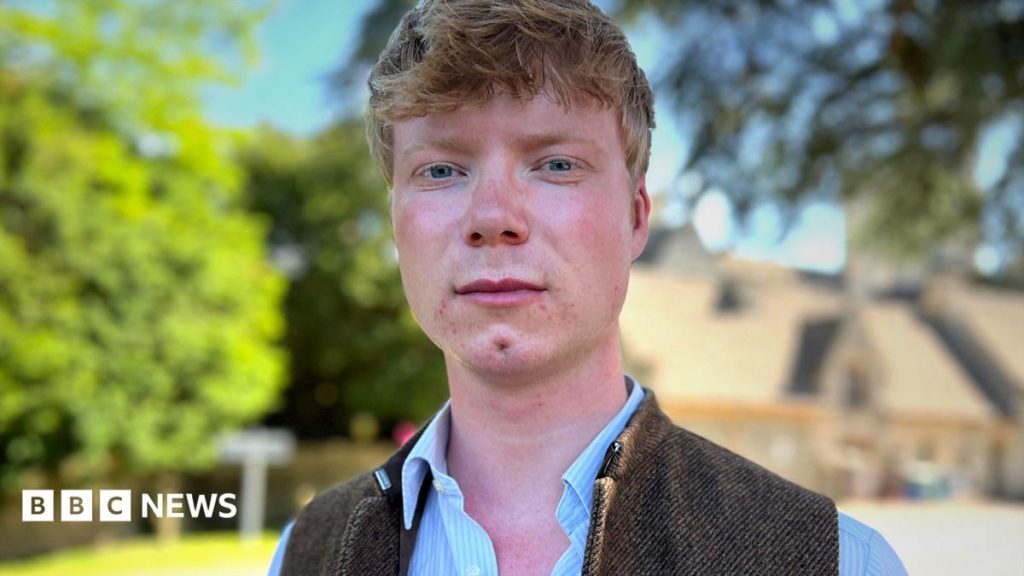
Lewis Jackson has been blocked from joining the British Army on medical grounds
Published5 hours ago
Lewis Jackson cannot remember a time when he did not want to join the army and continue a family tradition of military service going back to World War One. That dream was shattered, though, when his application was rejected on medical grounds.
"Serving my country has always been a dream of mine and I never considered that I'd do anything else," said the 21-year-old.
Jackson, from Cirencester, was turned down by the Army because he had cataract surgery at the age of three.
A Ministry of Defence (MoD) spokesperson said: "Service in the Armed Forces is physically demanding, so it's right that we have sensible health and recruitment policies which maintain operational effectiveness but don't unnecessarily exclude people."
The BBC has spoken to potential recruits and professionals who question whether the rules are too strict while some applicants said they had been prevented from joining because of medical conditions they regard as minor or no longer relevant.
Jackson spent his teens in the cadets, preparing himself for a career in the Army
Jackson spent his teenage years in the Army Cadets where he was recognised in his unit as the best shot.
He applied to join the Army Reserve, motivated by a desire to "give back" to a country which he said had given him "so much", but he was rejected.
"It's very frustrating, especially when you know that you are fit and healthy and you haven't even been given the opportunity to fail," he said.
There were 108,020 applications to the British Army Regular Forces in the year leading up to September 2025.
Separate figures obtained under a Freedom of Information (FOI) request to the Ministry of Defence (MoD) showed more than 114,000 applications to the Army were rejected on medical grounds in the past five years.
Psychiatry, eye and musculoskeletal conditions were some of the most common reasons for rejection.
An MOD spokesperson said: "The majority of these figures cover years before the substantial changes the government has made to remove over 100 outdated and unnecessary recruitment policies."
Jackson was the top shot in his cadet force
The figures come against a backdrop of wider recruitment challenges for the armed forces.
Latest UK defence personnel report figures showed the military remained at about six percent below its full-time trained strength target with a shortfall of 8,460 personnel.
Jackson said he had appealed against the rejection, providing a range of supporting evidence, including a note from a consultant ophthalmic surgeon who said his vision was now "excellent in both eyes" and "everything was stable".
But although his vision now meets the standard, he is ineligible because medical entry rules mean applicants who have had lens replacement surgery are considered "unfit" as they need "the visual function to be able to perform their role safely and effectively".
He has been told he is "permanently medically unfit to serve".
Jackson said: "We are missing out on young men and women who are passionate about serving but instead are pursuing different careers.
"I think it is ludicrous. If you're fit, you should be able to join."
One of Jackson's relatives was awarded a medal for bravery during World War One
GP and Labour MP for Stroud Dr Simon Opher said there needed to be a "more sensible approach" to medical screening.
"If a health condition is stable and it's not affecting someone's functional ability, then there's no reason to exclude that person," he said.
"We have to get that balance right between what's happened in the past and what would actually affect an armed forces personnel in their day-to-day duties."
The MoD sets out the medical standards in a document known as the Joint Service Publication (JSP) 950 Medical Policy.
In 2024, it reviewed recruitment policies, including removing a ban on applicants with asthma and severe acne.
But for 20-year-old Ben Smith those changes have made little difference as his application was rejected because of ongoing use of an inhaler.
Ben Smith wanted to follow in the footsteps of his father
Smith, from Blandford Forum, Dorset, wanted to join the Royal Air Force (RAF) but asthma has prevented him from doing so.
"There is nothing more I wanted to do in the world," he said.
"I'd led 250 cadets on parades and then, for all of that to come crashing down when I didn't have a back-up plan, it was horrible."
After rising through the cadet ranks, Smith studied military protective services at college and dedicated himself to reaching the fitness standards required for service.
"I was proud," he said.
"I was lifting double my body weight in the gym and my bleep test scores were constantly improving."
Smith uses an inhaler to treat asthma but he said it did not affect his fitness
Inspired by other family members who had served in the armed forces, he applied to join the RAF, hoping to train as either aircrew or a mechanic.
However, his application was rejected because he uses an inhaler.
Smith's appeal included a letter from his GP which said he had an "unlimited exercise tolerance".
The letter said: "He is a fit and active young man with a strong ambition to join."
His appeal was unsuccessful.
The review said: "All candidates, irrespective of role, need to be a minimum of 12 months treatment, symptom and medication-free."
For Smith, the decision brought his life-long ambition to an end.
"The dream has ended," he said.
"I've been told no. I don't know what to do with myself."
Lt Col Stuart Crawford said the military must "relax its medical policies"
Prof Neil Greenberg, president of the Society of Occupational Medicine, said: "The military has to have strict standards of physical and psychological health.
"It requires people to go all around the globe, often at short notice, and to put up with environments that really are quite unpleasant.
"It is vital that soldiers can perform to a very high level because if it goes wrong, it could mean loss of life."
Former British Army Lt Col Stuart Crawford, who was previously a defence spokesman for the Scottish National Party (SNP), said the military was "losing out on talent".
He said: "Recruitment policies must be in place, of course, but we need to be careful that we are not turning away talent because of minor medical issues."
He said this was "increasingly dangerous" in a time of global instability.
"We're always being told that we could be at war and we are nowhere near rising to that challenge in terms of our recruitment," Crawford said.
An MoD spokesperson said: "Each application is considered on a case-by-case basis by specialist clinicians, assessing the severity of any condition and the individual's ability to train, deploy and operate."
Jackson said the MoD needed to go "much further" in its review of recruitment policies.
"We're blanketing out thousands of young men and women," he said.
Jackson is currently studying agricultural management at the Royal Agricultural University in Cirencester.
"I'm in a lucky situation being at university where I have the time to fight my case alongside my studies," he said.
"But for many people, it's just not feasible to spend hours a week trying to fight the system."
منبع: بی بی سی