It was, says Ido Rakovsky, like reporting on "science fiction", rather than sport.
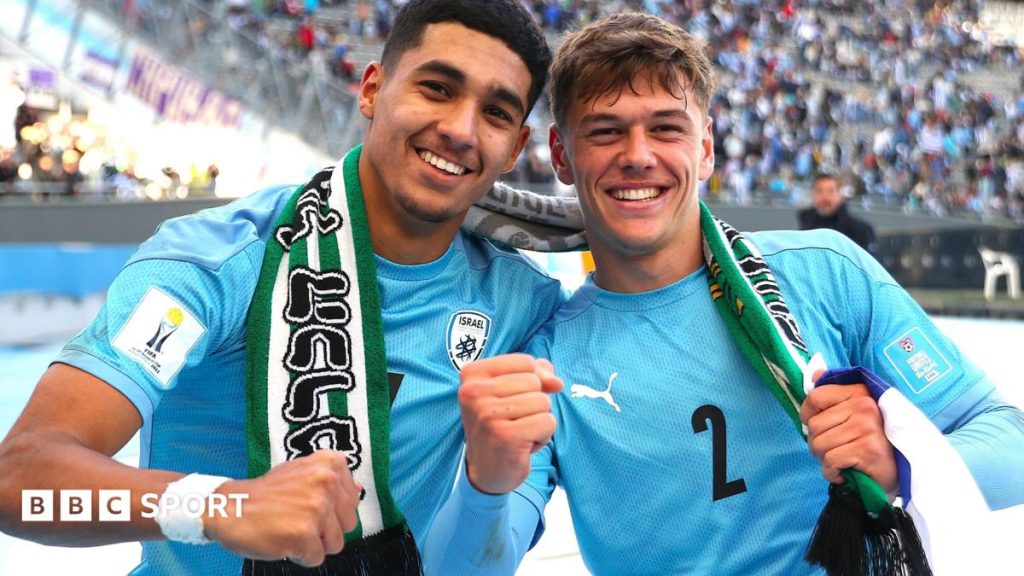
Israel, whose senior team have qualified for the World Cup just once, had beaten global powerhouses Brazil in the quarter-finals of the under-20 version of the tournament.
At the final whistle, the commentator covering the match for Israeli television vowed "you will tell of this night to your children, and they will tell it to your grandchildren".
Five days later, the team's semi-final against Uruguay was the most-watched thing of the evening on Israeli television, drawing a 23% viewing share.
Politicians clamoured to congratulate the team.
"That summer, everybody was watching under-20 football, everybody knew the players," says Rakovsky, who was covering the team for Israeli media outlet Haaretz.
"Everybody in Israel fell in love with these kids."
It wasn't just their deeds on the pitch that felt otherworldly, though.
After scoring a stoppage-time winner against Uzbekistan in the last 16, Anan Khalaili had given an interview to Israeli television.
In it Khalaili, an Israeli Arab, thanked the viewers back home for staying up late to watch his team win in Argentina.
To do so, he used the words 'Am Yisrael' – a Hebrew phrase that means 'People of Israel' and is bound up in Jewish religion, community, culture and history.
"That an Arab player used that figure of speech said something about the identity of that team," says Rakovsky.
"That team made real the claim that football can really bring people together – that Muslim players are part of the national team of the Jewish state, representing Israel and creating something better, both for the present and future."
But a little over four months after Khalaili's interview and the win over Brazil, Hamas attacked Israel.
The armed Palestinian group killed about 1,200 people and took 251 hostages. In response, Israel launched a massive military offensive in Gaza. The United Nations believes the retaliation has killed more than 70,000 Palestinians., external
As the war goes on, can the potential of a golden generation of Israel's footballers, in sport and society, be realised?
Israel beat Brazil 3-2 in the quarter-finals of the U20 World Cup in 2023
Beaten 1-0 by eventual champions Uruguay, Israel finished third at that Under-20 World Cup in 2023.
Their run was no fluke.
The same set of players, with a few additions and omissions, had already impressed at continental level.
They were runners-up at 2022's Under-19 Euros, beaten by England in extra-time in the final, and would go on to make the semi-finals of 2023's Under-20 Euros.
Israel has produced outstanding players in the past. Eyal Berkovic and Yossi Benayoun were technical, gifted attackers with long Premier League careers.
But a depth of talent, emerging together, sets the current cohort apart.
Khalaili has been one of the most sought-after young prospects in Europe this summer.
After his £21.5m move to Inter Milan fell through, Crystal Palace saw off competition from Nottingham Forest to pick him up for a similar fee from Belgian side Union Saint-Gilloise.
Playmaker Oscar Gloukh, 22, wears Ajax's number 10 shirt after his form earned a move from Red Bull Salzburg.
Left-back Roy Revivo signed for Spanish club Elche on transfer deadline day this month from Maccabi Tel Aviv, while Twente defender Stav Lemkin, also 23, is also highly rated.
Dor Turgeman, Ilay Feingold and Idan Toklomati are impressing in Major League Soccer in the United States.
All have now won full caps, but were moulded into a collective, cohesive unit – something that has often been beyond the senior side – by Israel's age-grade coach Ofir Haim.
"It isn't an issue at all here," Haim said, external of the different backgrounds in his squad during the 2023 Under-20 World Cup.
"We don't have any problem with religion. Not at all. We have players here who put on tefillin [Jewish ceremonial wear, containing verses from the Torah] – and Anan [Khalaili], Hamza [Shibli] and Ahmed [Salman] perform the Muslim prayers.
"We don't even talk about this. We unite everybody, and I wish the country were as united as this team."
Ofir Haim managed various domestic teams in Israel before becoming head coach of the U19s and U20s
Football has long been the part of Israeli society where communities mix together who may not otherwise meet.
"The majority of the Jewish people who arrived in the mandate period [a spell between 1923 and 1948 where the region was run by Britain] emigrated from Europe," says Dr Omer Einav, a historian and author of Defending the Goal, a book on Israel's football history.
"They were Europeans and when you think about cinema, music, theatre, dance, they had nothing in common with Middle Eastern culture. Nothing, except football. That was the only common language, the only thing they both love in the same way."
Encouraged by the British administrators who ran the region, teams from different communities, and some made up of elements of each, would play against each other.
When the modern state of Israel was formed in 1948, much of the Arab population that remained inside its borders continued to identify as or with Palestinians. Most still do.
They are also an intrinsic part of Israeli football.
While they make up 20% of Israel's population, they represent about 35% of those involved in the sport at elite level nationally.
The first Arab player to represent Israel's national team was Rifaat Turk in 1976. In 2018, Bibars Natcho became the first Muslim to captain the team.
Neither was without controversy.
Turk was roundly abused. Natcho's decision not to sing Israel's national anthem, the lyrics of which relate to the Jewish search for a homeland, was condemned by some., external
For a short time in the summer of 2023, it seemed as if Haim's under-20 side might offer a watershed moment of unity and co-existence.
But football, like everything in Israel, changed on 7 October.
Israel came second in their group at the U20 World Cup and went on to finish third in the tournament
Matan Segal directed Kick It Out Israel, an anti-discrimination initiative with similar aims but no link to the English organisation of the same name, for almost four years before stepping down a few months ago.
Racism has long been present in Israeli club football. Beitar Jerusalem's fans are among the most notorious.
In 2013, ultras burned down their own club's offices in protest at the signing of two Chechen Muslims.
The most extreme Beitar fans have long taunted Israeli Arabs with chants of "may your village burn", while declaring themselves "forever pure".
However during his time at Kick It Out Israel, Segal saw racism against Arab players become more virulent and widespread.
Covid, during which fans radicalised online during lockdown, was one cause.
The election of Israel's far-right government at the end of 2022, legitimising views towards Palestinians that were previously seen as extreme, was a second.
The war was undoubtedly another.
"Before 7 October, people generally respected the Arab players," Segal said.
"Even though they had difficulties with them not singing the Israeli anthem, they respected them and they could talk about it.
"After 7 October though, we saw an increase in racist remarks.
"It was happening at small clubs where we hadn't seen it before. There were terrible songs – 'Let's kill all Arabs', 'There are no schools in Gaza because there are no children left'."
Football, inevitably, has become a focal point for emotion generated by the conflict.
Clubs which are usually bitter rivals came together to remember those killed by Hamas. Scarves were part of the commemoration at the site of the Nova music festival, where hundreds were killed.
Hapoel Jerusalem's club badge now features a silhouette of Hersh Goldberg-Polin, who was abducted and killed in captivity and whose parents have campaigned for peace through their grief.
Meanwhile, Israeli Defence Force (IDF) soldiers have posed with club flags and banners while on operation in Gaza, dedicating their actions to the clubs and ultras back home., external
In such a heightened atmosphere, young footballers – closely connected to the conflict through Israel's programme of national service and a barrage of online commentary and images – are under constant scrutiny and pressure.
Gloukh's lifelong friend Afik Tery was killed by a Hamas explosive while serving in the IDF.
After his death, Gloukh posted a poignant set of pictures, external of the pair arm-in-arm over time – as young boys at birthday parties, as young men at a wedding – with the final slide showing Tery's funeral.
Among the online replies were the taunts of pro-Palestinians.
For Israel players with Palestinian heritage, the stakes are especially and dangerously high.
Dia Saba plays in a similar playmaking role to Gloukh. The 33-year-old has scored three goals in 13 appearances for Israel.
He is unlikely ever to add to that tally.
Saba was one of Maccabi Haifa's most high-profile stars when, at the start of the conflict, his wife Narmin posted a message to Instagram.
"There are children in Gaza, too," she wrote.
Saba apologised for the outrage caused, but could not save his career in Israel. He left Maccabi Haifa in 2025 and now plays for Turkish side Amedspor.
"My dream was to play for Maccabi Haifa, the club that I support, the team that I grew up with," Saba said at the time.
"I wanted to continue. But sometimes there are reasons that are stronger than us that don't allow it."
Former Israel Under-21 player Ataa Jaber (right) switched nationalities to represent Palestine in June 2023
Saba and others are used to having their loyalty questioned. From all sides.
Many in the Arab world would like more Palestinian prospects within Israel to follow the example of Ataa Jaber.
Jaber captained Israel's Under-21 side but switched nationalities, external to represent Palestine in June 2023, saying he could no longer separate sport and politics after seeing police evict Palestinian families from their homes in Israeli-occupied East Jerusalem.
Switching away from a high level of international football damaged his prospects of a move to Europe. At home, there were calls for his Israeli citizenship to be revoked. But, for Jaber, it was preferable to representing a country whose actions he deplored.
Those footballers who voice an opinion on the conflict choose their words carefully.
Beram Kayal, the former Brighton, Celtic and Israel player, knows the dilemmas and reality well.
"To be Arabic in Israel, it's sometimes hard," he says. "Sometimes it is tough.
"Opportunities-wise, sometimes we are not on the same level."
However, he believes in a pluralistic future for Israel and football as a tool to achieve it.
His friendship with Tomer Hemed – whom he first met as a young teenager at Maccabi Haifa's academy and later played alongside at Brighton and Charlton, as well as international level – sums up his approach.
"When I played with Tomer, he prayed like this," he says, touching his hand to his back of his head to indicate a kippah, the small skullcap worn as a sign of Jewish faith.
"And I was praying for Allah," he adds, raising his arms above his shoulders in worship.
"He was my team-mate and he is my brother.
"In football, on the pitch, you never look at colour, culture or religion. You just want the best people around you to win the game."
The 38-year-old is now employed by Israel's Football Association to work with young talents from Palestinian areas.
In doing so he works alongside former Israel goalkeeper Boni Ginzburg, who played across Glasgow at Rangers and is now the IFA's technical director.
After Arabic was relegated behind Hebrew as Israel's official language by a controversial 2018 law promoted by prime minister Benjamin Netanyahu, the IFA put on Hebrew language lessons for Arabic-speaking coaches to ensure they could still obtain their qualifications.
"Not in our building," says Kayal when asked about the precedence given to Hebrew.
"I'm in this place [the IFA] to bring the culture of the Arabic people to the table.
"I say to the Arabic players when they come into the national team: Speak in your language, don't be afraid, don't be shy to speak, don't just afraid to show yourself.
"Israel is a young country. We need to learn from our DNA, to see the different between the Jewish, the Circassians, the Arabic, the Muslim, the Christian, the Druze – all the colours – put that together and learn what we could do better."
Israel are aiming to qualify for Euro 2028
Israel's aim is to go better than their national team has managed in more than 50 years.
Ran Ben-Shimon was appointed as the senior side's head coach in 2024. He was given the goal of converting youthful promise into qualification for Euro 2028, which will be staged in England, Scotland, Wales and the Republic of Ireland.
Success would place more stress on Israel's players and, potentially, squad unity.
Large-scale protests are planned for Republic of Ireland's forthcoming Nations League matches with Israel. Dublin will host seven games at the tournament.
Villa Park in Birmingham, from which Maccabi Tel Aviv fans were banned from attending a Europa League match in November, will stage four matches.
Hampden Park, two miles across Glasgow from where Celtic fans have held vociferous pro-Palestine protests, has six.
Wherever Israel play, players will be confronted with criticism of their country's treatment of Palestinians, both at home and in Gaza, that is rarely voiced at home.
"Israelis are very sensitive to anyone showing any kind of sympathy for what happened on 7 October," says Dr Sophia Solomon, part of Ben-Gurion University's Center for Sports Diplomacy.
"It is like denying the Holocaust, that is the proportion of it. A war is a special situation, it wasn't like this before, but to express your agony became more encouraged as we saw the European arena become more anti-Israeli.
"One reaction ignited another and there is more obligation to identify yourself with the victims of 7 October."
She believes that it will take time for Israeli society, footballers included, to understand the past three years and speak openly about the conflict.
"Until the ongoing war ends, no-one can say what he thinks," she said. "Even after the Middle East returns to its 'normal' craziness, maybe it will take a decade to pass before people can start talking about their experiences and expectations.
"Time has to pass until you can touch certain areas, and at the moment you can see a lot of avoidance about talking about it, even mentioning it."
Anan Khalaili, who scored in Israel's Under-20 World Cup victory over Brazil in 2023, joined Crystal Palace this summer
The time for this stellar generation to fulfil their potential may come before that.
It may not. Translating youth-level promise to senior-level product is never simple.
But, whatever the future holds, for a few months, in the summer of 2023, Haim and his team gave Israel something special.
"We saw Anan Khalaili and Hamza Shibli scoring against Brazil and that was our hope, that was the future. That was our future," says Einav.
"I'm not so optimistic, but people thought maybe it's really a magical thing that can help Israeli society in general.
"There was something there, something new, something where people said 'OK, if we co-operate, if we work together, we can also succeed in sport.'
"That's what we all care about, right? We want to be good at sports. We are sick of watching the World Cup from our living room.
"I think football is in some isolated, sterilised dimension – some kind of bubble – inside Israeli society. It is not hermetic. A lot of dirt comes in – racism, violence – but I do believe that football can reflect good things that can happen. The equality of chances, the tolerance and solidarity of all people living here.
"It can't heal anything but it can help us see one another in a more human way.
"So, yeah there was definitely a moment, but it was before our world changed and collapsed."
Only time will tell what remains of that moment and whether it can be revived.
منبع: بی بی سی