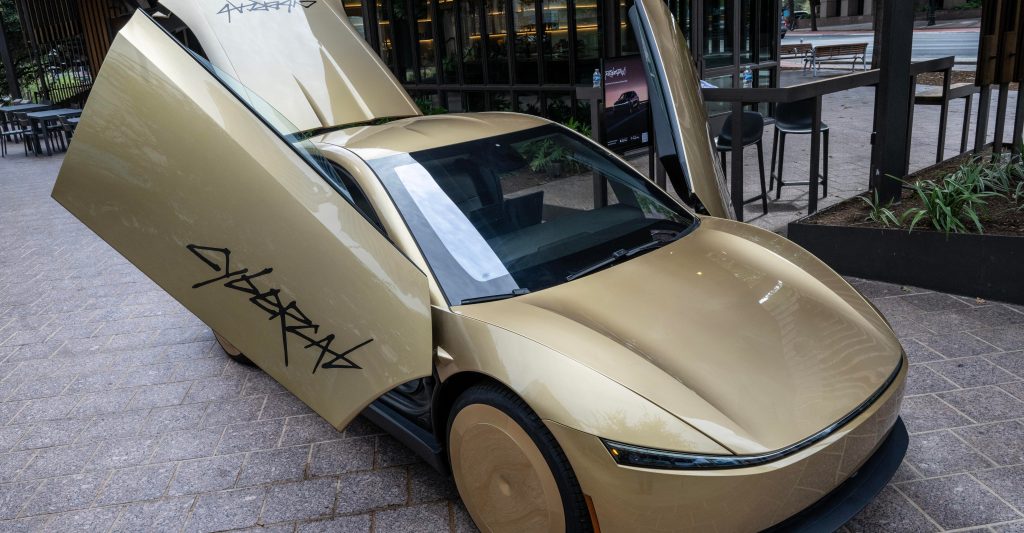
Elon Musk’s gilded robot car barely made it on public roads before federal regulators launched an investigation into the vehicle’s lack of traditional features — many of which are required by law.
The National Highway Traffic Safety Administration said it was opening an audit query (AQ) into the Tesla Cybercab “to examine the process and technical data on which Tesla relied when certifying the Cybercab and related issues.” At issue is the absence of certain design features such as sideview mirrors, pedals, and steering wheel — all of which are required under the Federal Motor Vehicle Safety Standards, or FMVSS.
“Among other things, NHTSA will consider the extent to which Tesla’s certification depended on determinations that certain FMVSS are inapplicable to the Cybercab,” the agency said in a notice. Tesla does not appear to have sought an exemption from these FMVSS rules, thus prompting the investigation. NHTSA’s investigation covers an estimated 1,000 Cybercabs, although its unclear whether there are even that many to begin with. Tesla has 45 Cybercabs currently registered with the Texas Department of Motor Vehicles.
“NHTSA fully supports the safe development and deployment of automated vehicles. But as the federal regulator, we need to ensure that all of our laws are followed,” NHTSA Administrator Jonathan Morrison said in a press release. “Our approach of balancing innovation with safety oversight will allow the United States to maintain its global leadership in AV innovation.” NHTSA is currently considering a handful of rule changes that would make it easier for automakers to sell driverless vehicles without traditional controls.
But the agency is also trying to get a grip on the rapidly expanding robotaxi market, issuing a letter recently warning operators about vehicles that block emergency responders. Tesla held a private event in Austin Thursday to celebrate the public launch of the Cybercab. Tesla has said it plans on deploying the vehicle in other cities as part of its Robotaxi service, and will eventually sell the Cybercab to individual customers for an estimated price of $30,000.
In the US, automakers self-certify that their vehicles comply with all the applicable rules in the FMVSS. If there are problems, or a certain vehicle is introduced with glaring issues, like the absence of legally required safety features, then NHTSA can launch an investigation into that self-certification process. That doesn’t block the automaker from continuing its production, but it certainly calls into question that vehicle’s future prospects.
The same thing happened to Amazon’s Zoox when it launched its toaster-shaped, steering-wheel-free autonomous shuttle in 2024, claiming that it complied with all safety standards. NHTSA subsequently launched an investigation into that self-certification process, and while the investigation was ongoing, Zoox was allowed to operate its vehicles, but for demonstration purposes only. The company couldn’t charge passenger fares until NHTSA granted it permission just this past July — two years later.
That certainly raises the question whether Tesla will be allowed to charge for rides in the Cybercab while NHTSA’s investigation is ongoing. Musk is obviously friendly with the Trump administration, but not necessarily with Transportation Secretary Sean Duffy, who oversees NHTSA. (Musk has reportedly called him “Sean Dummy.”) So I wouldn’t necessarily expect any favorable treatment for Tesla, despite the CEO’s status as a major GOP donor. Of course, this isn’t the only NHTSA investigation into Tesla at the moment.
The agency is also probing 3.2 million Tesla vehicles with Full Self-Driving, which could lead to a potential recall. But this certainly lines up with Musk’s philosophy of seeking forgiveness rather than permission when your products skirt the rules. Update September 4th: Updated to include a statement from the head of NHTSA.
منبع: ورگ