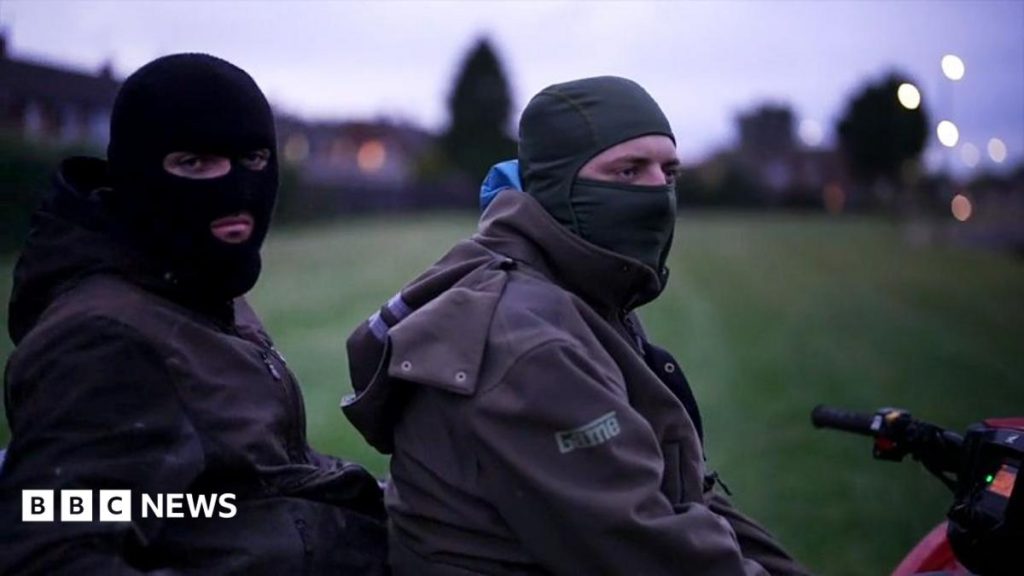
Two young men riding a quad bike in Grangetown, near Middlesbrough, came over to speak to us
Published2 hours ago
It is just after 8pm in Grangetown, near Middlesbrough, and the light is fading.
Two teenagers in balaclavas tear across a park on a muddy red quad bike, pulling wheelies as they pass a man walking his dog.
Younger boys, some not yet in their teens, gather excitedly around the bike.
We're here because Grangetown and neighbouring South Bank now find themselves at the centre of a large police operation, with fears organised crime is out of control after the deaths of two police officers and five young men in a car crash on the A66.
Suddenly one of our team is hit by a pellet, which appears to have been fired from the group. It stings but he's OK.
Then the quad riders pull over for a chat, engine running.
I ask the riders if it is normal to be driving around the park on a quad bike.
"Yeah, this isn't any special day," the passenger says. "You're born and bred and brought up with it. What do you expect? You don't know anything different."
Since the crash, more than 20 people have been arrested in Middlesbrough and the surrounding area as part of a wider operation into what police have called "serious and organised crime".
Sources say there are two feuding gangs at the centre of a spike in violence.
Is this area out of control, I ask the quad bike riders.
"No. Definitely not."
Then they reveal something we repeatedly heard from young people here. They do not trust the police.
"They're saying there are gangs, but there are no gangs," the driver says. "It's not London, mate. Do you know what I mean?"
Like many young people here, they blame the police for the deaths on the A66. The circumstances remain under independent investigation.
The quad bike riders we met said they felt the area wasn't out of control
What we do know is that on Saturday 22 August, a Volkswagen Passat that had been pursued by police travelled the wrong way along the A66 and collided head-on with a police vehicle.
PC Matthew Blades, 37, and PC Tom Clough, 38, were killed. So were all five people in the Passat: Michael Cahill, 23, Jakub Matusiak, 23, Makai Saddington, 18, Theo Rae and Cole Worthy, both 17.
Four of the five young men killed had amassed 30 convictions between them for offences including car theft, drug possession, assaulting police officers and driving offences. Cahill had no convictions.
The chain of events that ended on the A66 is believed to have begun eight miles away, in a quiet suburban street in Acklam.
It feels a world away from Grangetown. Hanging baskets and neat front gardens line the bay windows of 1930s semi-detached homes.
Many residents are reluctant to speak. Why? Because of what happened to one house here that stands behind large metal barriers.
A car was rammed into the bay window, exposing the room inside. Some of the other windows were also smashed.
Fragments of lights and bumper remain scattered across the driveway.
The home belongs to Cole Worthy's father, Gye Worthy, and the ramming happened on the same night Cole died.
Police say the car used in the attack was a Volvo XC60. The BBC understands that Cole Worthy and the four others then set off in the Passat to find the Volvo.
Now neighbours describe a street living in fear and say the home has been targeted for more than a year.
There is no suggestion that Gye Worthy is involved in criminal activity.
Gye Worthy's house was rammed on the same day as the A66 crash, which killed seven people
All but one of the residents who speak to us do so on the condition of anonymity. They are worried that showing their faces could place them or their homes at risk.
What message do the attacks send to people on this street, I ask one.
"Well, they should be scared, shouldn't they, that something's going to happen to their property if they say anything or get involved. So we don't."
Victoria, who moved here several years ago, says the escalating violence cannot be separated from the wider condition of the town.
"This is a social problem, especially in this area. Teesside has been massively neglected and ignored," she says.
The attack in Acklam is far from Middlesbrough's only recent case of a vehicle being used as a weapon. Back in May, a tractor was driven into a house on Priory Road, and since the A66 crash Cleveland Police has investigated at least two further rammings.
Detectives have also linked their wider investigation to a caravan fire on Attlee Road in Grangetown.
"It's getting worse," a nearby resident says. "They're always balaclava-ed up as well, do you know what I mean?"
"It can't be anything else. Why would you be like you are unless it was drugs?" he says.
Whether every incident is part of a single feud has not been established. But taken together, the rammings, fires and arrests have created a powerful sense that violence is being used to intimidate, punish and send messages.
What is most unsettling for these residents is the sense that nobody is fully in control.
Grangetown and South Bank are communities still living with the void left by the decline of heavy industry. Both now rank among England's most deprived neighbourhoods.
In South Bank, we see a group of teenagers tend three ponies tethered on the grass. Two perform wheelies on electric scooters while another uses a long stick to scatter rubbish.
On the adjoining estate, more than a dozen homes have boarded-up windows.
On a wall are the words "RIP 2UZZI", said locally to have been the nickname of Jakub Matusiak, who lived one street away.
One 17-year-old boy tells us he knew him. "He was my best mate," he says. "It's sad."
Elsewhere, three letters are repeated: "FTP" – an expletive directed at the police.
I ask the teenager if he would call the police if another young person approached him carrying a knife.
"No," he says. Before adding: "I've never needed the police in my life. I'd rather die than ring the police."
Again and again, the young people we speak to express a profound distrust of the police.
Cleveland's Chief Constable Victoria Fuller said what we'd heard was "horrifying".
"Yes, there are a small minority of people in the Grangetown area who blight those communities. But we will continue relentlessly to serve our communities."
The scale of the challenge facing the force and the community it serves is not new.
The area has some of the highest police-recorded crime rates in England and Wales.
Its leaders have been warning for years that its resources did not match the demands placed upon it.
But recent inspections show Cleveland is one of the most improved forces in England and Wales, with performance levels also judged to be some of the best in the country.
The force has recently arrested 87 people for offences linked to organised crime gangs and over the past two years 16 people have been jailed for such crimes.
Since the crash, more than 200 additional officers have been deployed in Middlesbrough and surrounding communities. Their immediate task is to suppress the violence and identify those directing it.
There is also the question of restoring order and rebuilding trust and confidence.
The graffiti is a tribute to 2Uzzi, said to be the nickname of Jakub Matusiak – one of the five people who died in the A66 crash
As darkness settles over Grangetown, the quad bike is still circling the field and one woman, who moved here not long ago, asks us to move our car from outside her home, frightened we will be targeted and her property will become collateral damage.
But what worries her more is her children's future. "I'm terrified my son will end up like them, he's only 10, I don't want him to grow up like that," she says gesturing to the lads with balaclavas tearing up the grass on the quad bike.
Additional reporting by Brijesh Patel.
منبع: بی بی سی