Published2 September 2026, 14:15 BST
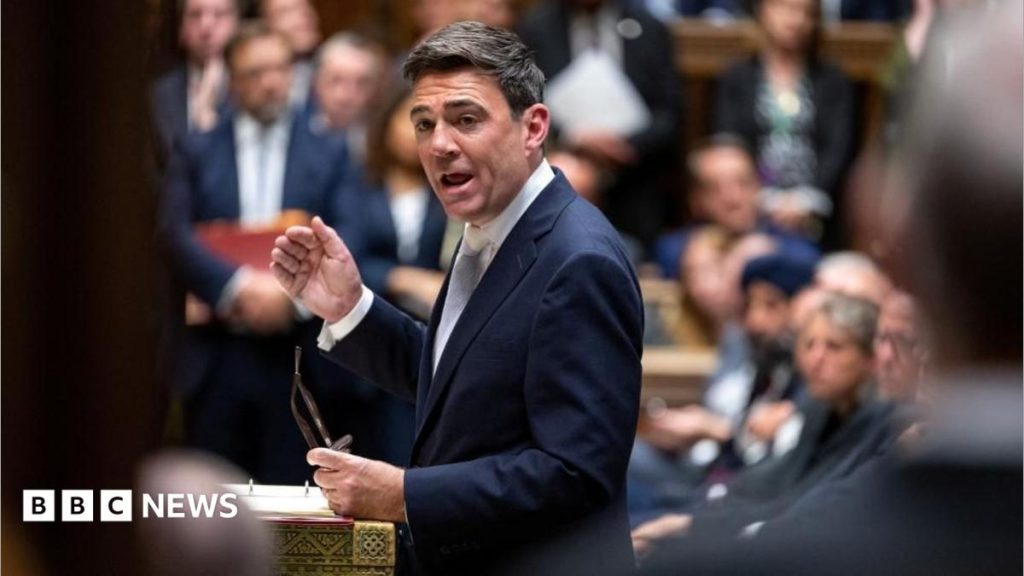
Andy Burnham said his government would be "grounded in fiscal responsibility" as his first Prime Minister's Questions took place against a backdrop of rising UK borrowing costs.
Conservative leader Kemi Badenoch called on Burnham to say where spending would be cut and how he would deal with the UK's increasing debt, after the cost of borrowing for the UK reached a new 18-year high on Wednesday.
He blamed the previous Conservative government, saying the "turbulence on global markets are because of that exposure that they left behind".
Burnham took over from Sir Keir Starmer in July before Parliament's summer recess, making Wednesday the first time he had faced the Tory leader at PMQs.
Burnham sought to stress his administration's fiscal responsibility and said ministers were taking steps to reduce debt.
He told MPs: "This will be a government grounded in fiscal responsibility. It will stick to the fiscal rules, but at the same time, we will help reduce cost-of-living pressure on our constituents, and that's the approach that we will take."
Interest rates on government bonds have been going up, with the yield on a 10-year bond at its highest level since 2008, while the yield on a 30-year bond is at its highest since 1998.
This means it costs the government more to borrow over the long term and could constrain the government's spending choices as the 28 October Budget approaches.
Burnham's PMQs debut came after he used the summer recess to tour the UK, announcing a series of eye-catching policies mainly aimed at tackling the cost of living.
On Wednesday, Badenoch said the prime minister had set out plenty of spending plans but no detail of how he would be paying the bill.
"The markets are clearly worried that we now have a spendthrift prime minister who wants to say yes to everyone but cannot tell us where the money is coming from," she said.
"He needs to pay for all his new promises and he has a choice – higher taxes, more borrowing, or spending cuts.
"Yesterday he said change begins with honesty, so will he be honest and tell us: is he preparing to raise taxes again, yes or no?"
Burnham had earlier said he had already cut taxes, including VAT on energy bills and a cut in business rates for hospitality.
"I've already indicated my first moves were to cut tax, but I'm not going to do what any prime minister has done and write the budget here," he said, adding he and Chancellor John Healey had agreed on an earlier date for the Budget to reduce speculation.
In the Commons, Badenoch also raised comments from economist and cross-bench peer Lord Jim O'Neill, who had been tipped to become Burnham's chief economic adviser, but who ruled out joining Burnham's government.
Speaking to the BBC, Lord O'Neill had praised the PM for "a great first five weeks" which he said had helped lift consumer and business confidence; adding the current spike in market interest rates for government debt would force Labour to start "dealing with the triple lock" on the state pension, and "excessive" welfare spending.
Badenoch pointed to a warning from Lord O'Neill that the prime minister's tone during his Tuesday Commons debut would have unsettled investors, although the peer had also said that spike was mostly mirroring US market upheaval concerning the Iran conflict.
Kemi Badenoch speaking in the House of Commons at PMQs
"Lord O'Neill, a close friend of the prime minister, said yesterday's statement in the Commons was the last thing investors wanted to hear," Badenoch said.
"Lord O'Neill is a serious economist. He knows what he's talking about and, sure enough, yesterday the cost of government borrowing rose to its highest in 18 years.
"How does he plan to tackle the government's rising debt costs?"
Burnham replied that he and Lord O'Neill did "not always agree", before attacking Badenoch's shadow cabinet reshuffle for bringing MPs who were in the leadership team of former Conservative prime minister Liz Truss back to her front benches.
To shouts of "point-scoring!" from the Conservative side, he said: "Can I also say to her and the whole of her new shadow cabinet, the majority of whom were part of a government that lasted for 49 days, a short-lived government that crashed confidence in the economy and hammered people's mortgages.
"She took a decision at the weekend, she removed a shadow chancellor who said that the Truss mini budget was a mistake, and she replaced that shadow chancellor with one that helped to write the Truss mini budget."
In the Tory reshuffle, Andrew Griffith replaced Sir Mel Stride as shadow chancellor.
Badenoch said Burnham had not ruled out tax rises, claiming: "The reason why that budget failed was because spending was announced before the money to pay for it, which is exactly what he is doing right now."
The opposition leader went on to raise the alleged Russian attack on Leipzig airport in Germany, urging the prime minister to commit to 3% spending.
So far the new government has only committed to meeting the 3.5% spending target for defence by 2035, pushing back the interim 3% spending commitment to spring next year.
The new chancellor quit as defence secretary in June over the last government's failure to commit to a 3% increase, which proved to be the final nail in the coffin for Sir Keir's premiership.
Burnham told MPs: "The very reason I appointed this Chancellor to his position is because of his strong commitment to the defence of our country and to defence spending.
"We will fully fund the defence investment plan and at the spending review we will set out a plan to meet the Nato commitments by 2035, there is no problem with our commitment to defence."
منبع: بی بی سی