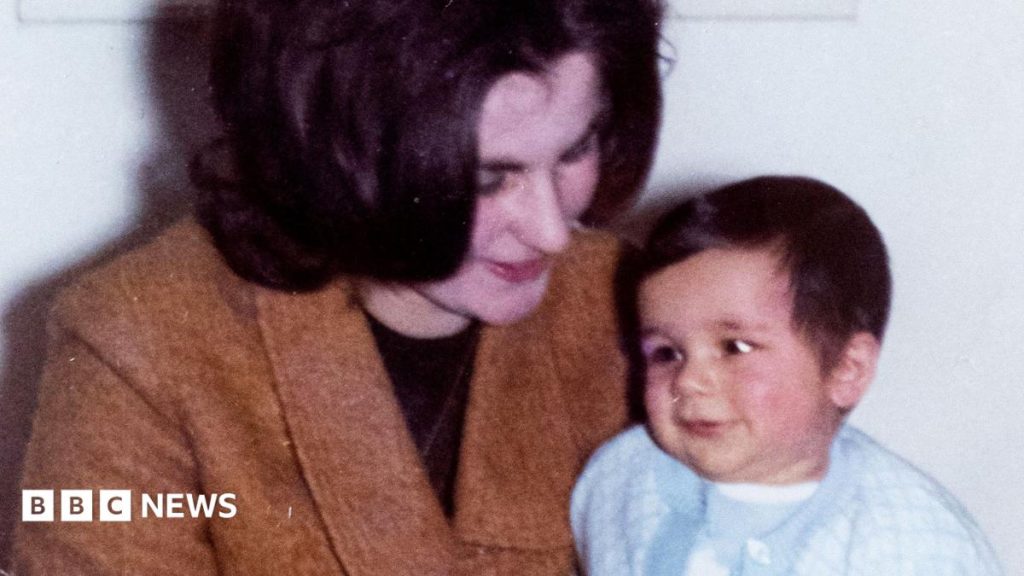
Marion only had a few months to get to know her baby before he was taken from her
Published30 August 2026, 01:52 BST
Marion McMillan was 17, pregnant and unmarried, when she made her first trip to England from her home in the south-west of Scotland.
It was 1966 and she was sent by her family to a maternity home run by the Salvation Army more than 150 miles away, in Newcastle-upon-Tyne.
The young mum spent nine months with her baby – a beautiful boy with "gorgeous wee black hair" – before he was taken from her.
She begged staff to let her keep him. "I said 'please help me keep my baby, don't let them take my baby, please' and he was gone," she told a new BBC documentary, Stolen Babies.
Warning: This story contains racist language and descriptions of sexual abuse and violence
It tells the stories of some of the 250,000 women who were forced to hand over their newborns for adoption between 1949 and 1976.
They were powerless against the will of the state, social workers and religious organisations, and the system which supplied infants to adoptive families.
"Let's face it, we were working class unmarried girls having babies that were being adopted by middle class women," another victim, Ann Keen, told the programme.
For years many of the women kept their ordeal – their shame – secret.
In July, outgoing prime minister Sir Keir Starmer issued a formal apology to those mothers, telling them: "The shame is not yours… the shame is ours."
Marion's story: 'They cannae take my baby away from me'
Marion fell in love with a refugee from Pakistan when she was 17
Marion grew up in Stranraer in the 1960s where she fell for an older man who had emigrated from Pakistan.
"I was in love at the time and it was so lovely, I never gave it a second thought," she said.
"We were only together just a few short times, and I'd never told my family but at 17 I became pregnant out of wedlock."
She hoped they would marry but her boyfriend knew their relationship would not be accepted.
"Nobody will want you to go with a black man, Marion," he told her.
In their last conversation, he suggested emigrating to Hawaii where he believed mixed-race marriages were more acceptable.
"I never saw him ever again after that," she said. "Didn't know what was ahead of me. The conveyor belt of 'unwed mother' took control, and that was when I lost control."
Marion McMillan said her son was born with a beautiful head of dark hair
She gave birth at Hopedene, a home for unmarried mothers where conditions were austere and treatment could be brutal.
"Everything, from the minute you cross their threshold, is that you're unworthy to be a mother and we're taking your baby from you," Marion said.
"It's going for adoption. So you better get used to that, girl, because you've no money, you've no place to live, you've not got anybody to support you."
While giving birth she was slapped across the face by the matron for trying to get off a bed.
"And I don't know what was worse, the shock of her doing that [or] being in heavy labour," she said. "And the next thing my son is born."
She wasn't allowed to hold him until the following day.
"I was absolutely terrified," Marion said. "Absolutely terrified that they're taking my baby. They cannae take my baby away from me."
Her son was taken from her when he was just nine months old
But Marion got to spend longer with her baby than some of the other girls in mother and baby homes across the UK.
"I was a Scotch girl with a half-caste, that's what the Salvation Army recognised me to be," Marion said.
"And of course you were told that half-caste is very rarely successful in adoption."
He was nine months old when he was picked out by his adoptive parents. Marion compared the wait to hand him over to death row.
"[The matron] took him, and she was weeping with me, and she must have had another member of staff that took him then, and she was still holding me."
Her desperate pleas to keep the baby were ignored.
Marion was finally reunited with her son in 2004.
Unwelcome back home in Stranraer, she ended up in a women's hostel in Glasgow.
"Suddenly I'm banished from where I was born and brought up and I'm entirely on my own again," she told BBC Scotland News.
Marion was finally reunited with her son in 2004, but her experience as a teenager continues to cast a long shadow.
"It's been painful for him, painful for me, painful for his [adoptive] parents, painful for everybody.
"But it you take away the pain it's been a gift from God because all the years I missed him."
The full scale of the UK's forced adoption scandal, as told by the mothers and children separated from one another
Watch on BBC Scotland at 21:00 on Tuesday and afterwards on BBC iPlayer.
Ann Keen: 'I was told I'd never see him again'
Ann Keen was refused pain relief during labour – an "awful ordeal"
Ann Keen was 17 and working in a toilet roll factory in Ewloe, Flintshire, when she was asked out by a handsome salesman.
"That's when it happened. In today's terms it was without consent. You didn't say that in the 60s," she said.
Like Marion, she was sent away so the problem could be "dealt with". She gave birth at an NHS hospital in Swansea, where she was denied pain relief.
"I was told I wouldn't have anything for pain because I would remember it, and I wouldn't be a bad girl again," she said.
"They saw me as a woman that didn't have any morality and therefore I wasn't worthy of any help. And I don't believe, had I been married that that would have happened."
Ann's son was taken away when he was just eight days old.
Ann was told that she could spend 10 days with her baby but on the eighth day she went to the nursery and he wasn't there.
A "cruel" midwife told her: "He's waiting for his new mummy. You'll never see him again."
She took her to a Victorian bathroom, put her in the bath and grabbed her breast.
The midwife told Ann: "I'm getting rid of this milk, you won't be needing it."
"And that's when I knew I'd lost everything," Ann said.
Joan Chambers: 'Teachers are supposed to be trustworthy'
Joan became pregnant when she 14
Joan Chambers was a 14-year-old schoolgirl in Sunderland when she realised she was pregnant.
A teacher had starting asking her to go for walks in the countryside.
"I wasn't alarmed by it, because, you know, he was a teacher and teachers are supposed to be trustworthy. I trusted him, I really did."
One day he raped her. "All I remember is the pain," she said. "I didn't understand what was happening."
Five weeks before giving birth, she had to give evidence against the man in court.
Years later she discovered archives that showed that the judge had told the jury not to believe her testimony.
She told the documentary that the judge said: "He's got a good career ahead of him, so don't let her being pregnant sway you."
She went on: "That hurt. It really hurt when I read that years later. For a judge to say that."
The man was acquitted.
Years later Joan discovered the jury had been told not to believe her evidence
Joan spent the last few weeks of her pregancy at a mother and baby home – but she said she had "blanked out" the birth.
"It must have been so painful. I wasn't given painkillers or anything like that, " she added.
"The next thing I remember is like my legs were up in stirrups, a green cover over my legs, waiting for the doctor to come and stitch me. I had been torn to shreds, absolutely torn to shreds."
Her baby was taken when he was three weeks old, a week before Christmas.
"They took him from me and then they told me to go back in the nursery and take the bedding out of his cot and get it ready for the next baby," she said.
Joan was 66 when they were finally reunited.
"It was amazing, but it was so sad," she said. "He'd never looked for me because he had a happy adoption."
'The apologies prove we weren't to blame'
In 2023, Nicola Sturgeon described Marion McMillan as "one of the most ardent campaigners" as she formally apologised for the role of the state in the forced adoptions.
"It was always cruel, unjust and profoundly wrong," Scotland's first minister said.
In an updated apology , externalpublished on Friday, The Salvation Army said it was "profoundly sorry and deeply ashamed" that vulnerable young women did not get the help they needed in their mother and baby homes.
"We know we must be held accountable for those we let down and reflect on our role in a society that worked against pregnant unmarried women," its territorial leaders, commissioners Paul and Jenine Main, added.
Marion says still more can be done. She wants more support for the victims of forced adoption – mothers, children and adoptive parents.
And she would like to see a centre of excellence for adoption in Scotland, where anyone involved in adoption can receive comprehensive training and support.
Ann was reunited with her son, Mark Lloyd-Fox, in later life
Ann Keen was among a small group of mothers invited to Downing Street ahead of Starmer's apology on behalf of the UK government.
"The apology to me means I'm no longer presumed guilty of something I didn't do, because I didn't give him away. He was taken," she said.
"It will prove to the world that it wasn't our fault. We weren't to blame. The state was to blame, the churches were to blame, and we will be free."
If you or someone you know has been affected by sexual abuse or violence, you can find details of organisations that can help at BBC Action Line.
منبع: بی بی سی