As audio-focused generative tools and platforms have gotten more sophisticated, the internet has become increasingly filled with AI-generated music whose melodies and vocals are algorithmically derived from the work of human artists. While some of the people pumping out this kind of content immediately own up to using AI, others have denied using the technology until increasing public scrutiny forced them to tell the truth.
For musicians — especially those creating art in technologically-focused spaces like electronic dance music — the increasingly complicated question of what is “real” and what isn’t feels particularly urgent and personal. Professional courtesy can make this only more complex; listeners can call out performers they suspect of using gen AI, but it’s something else for artists to raise concerns about their professional peers.
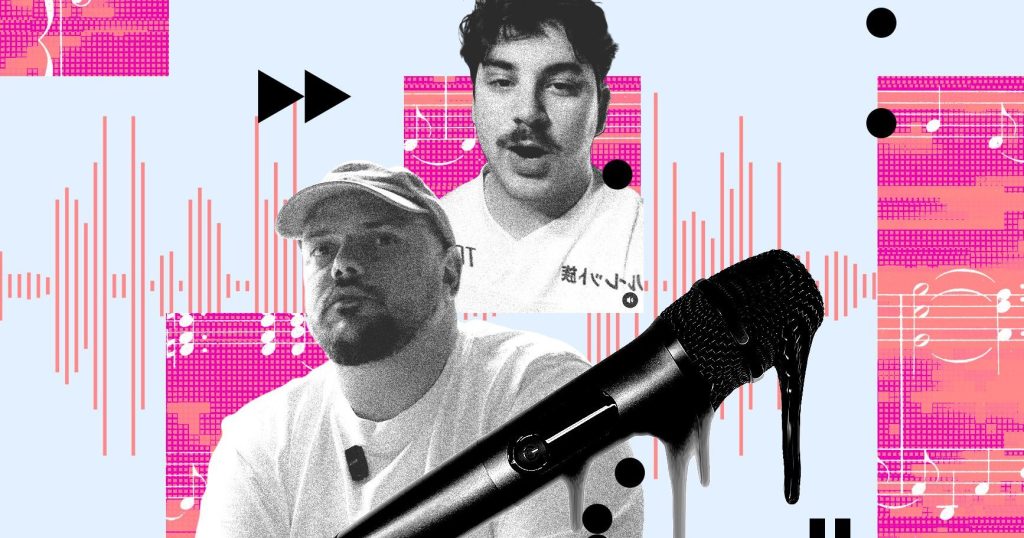
There are some though, like 26-year-old EDM producer Max “H4RRIS” Harris, who are taking a stand against generative technology with videos calling out anyone they believe is trying to pass off AI slop as human-made art. [Media: https://www.instagram.com/reel/DalEyjOMSNX/?igsi=YmR3NmZ2eThhd2lr] When I recently spoke with Harris, he told me that he sees AI-generated music as “a kind of decoy art form,” and he thinks that the people making it don’t really have anything meaningful to say with their creations.
He feels that true art in any medium is “created by people that are trying to express feelings and messages,” and he believes that the only thing AI boosters are really interested in is making a quick profit. “I don’t consider AI-generated material to be art, and I don’t think this technology is really advancing art in any meaningful way,” Harris said.
“It’s a technological advancement that’s giving people a way to steal real art and pass it off as their own.” Harris, originally from Maine, described his approach to making music as being fairly similar to working in other creative mediums.
He always begins with a core concept before he starts “throwing more ideas down until I find something that sticks.” And as complicated as his workflow might look to someone unfamiliar with all of the tools and programs that he uses — his production setup includes Ableton Live, Novation Launchkey 49 MIDI controller, Ableton Push 3, Launchpad X, a couple of analog synthesizers, Serum, Diva, and the software sampler Kontakt — he said that the entire process is “really just me making creative decisions” that culminates in a sound that feels right.
“Each of those decisions — and there’s hundreds of them to go into each song — brings me closer to evoking a specific kind of idea or emotion,” Harris explained. “And then once I have a song mapped out, I have to start making even more choices about how to mix it in a way that makes it sound good and presentable.” In Harris’ view, being a real artist means being able to make those kinds of experimental but informed creative decisions using your own studied understanding of a given medium.
One of Harris’ biggest issues with gen AI is the way the technology often eliminates a user’s need to think about how songs (or books, films, podcasts, etc.) come together. But he has also been dismayed at the way that AI posers are muddying listeners’ understanding of what human-made EDM actually sounds like. “Aside from the similar vocals, you can usually hear a sharp hissing throughout the track,” Harris said of AI-generated songs.
“I think that comes from the way that these models often work by starting with a big white noise block and then making guesses about waveforms by referencing data taken from real songs.” Harris pointed to MANSA’s “Midnight on My Mind” and Danny and Ian Asher’s “Take Me (To The Moon)” as what he thinks are examples of AI-produced songs that embody what he jokingly refers to as “the AI revolution” that’s responsible for polluting the EDM space. MANSA, Danny, and Asher have not publicly commented on whether they use generative tools in their music.
But Harris and other EDM fans have noticed the similarities between “Take Me (To The Moon)” and another person’s AI-generated track. There’s no definitive evidence that MANSA produced “Midnight on My Mind” with AI. Harris could very well be wrong about these songs being generated with AI. But his insistence that they are reflects the larger culture of mistrust that has developed in response to the growing presence of AI content online.
Harris holds AI production company Suno responsible for the recent spike in this kind of music being uploaded to the internet, but he also credits specific quirks of the platform for helping him learn how to spot songs worth calling out. “Something I’ve noticed with a lot of Suno-generated tracks is that a lot of the time, you’ll hear the vocals and other melodic elements will start stuttering at the same exact time,” Harris explained.
“These models still have a hard time fully separating different parts of the songs they’re trained on, and they treat these elements like one big instrument. As a music producer, all of these things come across like choices that a human just wouldn’t make with their compositions because it just doesn’t make sense.” In some instances, the visuals accompanying AI tracks are part of what prompts Harris to accuse people of slinging AI.
You might not be able to hear the generative models behind evangelical Christian AI persona Lionsaddle’s music, but you can clearly see the character’s fingers vanishing in and out of existence in videos. There is also an overly glossy visual quality to most of the videos posted by Christian house musician Midnite Manna that makes their content look a lot like what we typically refer to as AI slop.
[Media: https://www.instagram.com/p/DbQNzwfDkq_/] Suno also came up multiple times during my conversation with 39-year-old Italian turntabilist-turned-producer Nihil Young. Young’s posts on Threads about people using Suno are what initially inspired Harris to make his videos. Like Harris, Young has spent the past few months watching multiple EDM newcomers’ stars rise after they post music he thinks was generated with AI tools like Suno’s.
And while Young isn’t usually one to get involved with online discourse, he felt it was important to speak out about how many people are flooding the scene with AI tracks. “These songs are the sound of Suno, which to me means that the people behind the songs are just straight up uploading original, copyrighted tracks of artists like Madonna and asking the platform to remix them,” Young told me, referring to Josh Fawaz’s “Like a Prayer” cover, which now includes AI credits following a wave of online backlash.
“If they can do it with major artists like her, they can do it with you, me, and everyone else, which just isn’t cool. They can take your entire catalog, feed it to Suno, and generate ‘new’ songs from that stolen work.” Young claimed that in response to his Threads posts, he received multiple hacking attempts and a wave of online harassment from AI defenders. He also told me that he thinks people bought fake followers to boost his Spotify numbers as a way of casting doubt on his authenticity.
That spooked Young — who is raising a young daughter and just put out a new album of his own — to rethink whether he should continue. He’s taken a break from callouts, but he still thinks it’s important to know about the way AI music is harming human artists. “Music production is where most of my income comes from, and almost as soon as AI began rolling out, I started losing many of my clients,” said Young, who has previously done audio mixing and mastering work for Sony Music, Warner, and Universal.
“I can only imagine what it’s been like for singers, graphics artists, and people working in other creative fields. Whether you realize it or not, this stuff is impacting everyone.” What Young wishes more listeners could appreciate is how easy it has become to generate entire songs with platforms like Suno. In his opinion, most people using AI to make music “aren’t actually doing anything creative and they don’t have a true artistic process” because many generative tools on the market involve some degree of autogeneration.
When I brought up how detailed AI prompts can be, he insisted that many of the people posting AI music likely aren’t even writing their own inputs. Young noted that Suno’s Simple Mode allows users to whip up songs by simply selecting a musical genre and clicking a button — a process that requires basically zero thinking. (Suno has not responded to a request for comment in time for publication.) As much as traditional artists might loathe generative production, there is no denying that AI songs are making their way into the mainstream.
In 2024, Metro Boomin took shots at Drake with a beat sampling comedian King Willonius’ “BBL Drizzy” — an AI track whose vocals, melodies, and instrumental elements were generated by AI music startup Udio. Metro Boomin’s “BBL Drizzy” went viral after the producer posted the beat to SoundCloud and invited other performers to rap over it. Drake subsequently rapped over the beat himself on Sexyy Red’s “U My Everything,” and that song managed to peak at 44 on the Billboard Hot 100. Wholly AI-generated songs (and people) are finding success, as well.
Last summer, Vinih Pray’s Suno-created song “A Million Colors” also peaked at 44 on TikTok’s Viral 50 chart, and AI artists Breaking Rust and Cain Walker made it onto Billboard’s Country Digital Song sales chart — a lesser-known chart focusing on individual song downloads. Meanwhile, Hallwood Media — a label founded by former Geffen Records president Neil Jacobson — signed AI avatar Xania Monet to a $3 million recording deal.
Certain segments of the industry are clearly trying to normalize AI-generated music, and people are definitely making money with their machine-generated tracks. Kapwing estimates that the top 10 most followed / streamed AI music creators on Spotify and YouTube collectively raked in over $6 million in 2025. And with platforms like Deezer reporting that AI songs now account for over 50 percent of new uploads, that kind of music is getting harder for listeners to avoid — if they can even recognize it.
While streaming platforms are beginning to more clearly label AI songs, many listeners have reported that they can’t really hear the difference between generative and human-made music. Aside from the people uploading all of these songs, no one has a way of being absolutely certain whether the tracks were generated with AI or made by an actual artist. AI music detection tools are one potential solution, but it’s not entirely clear how and, perhaps more importantly, if listeners might incorporate them into their lives.
Judging by the numbers (which, of course, can be manipulated with paid streams), there do seem to be people who don’t mind the sounds of Suno and other AI tools. Young knows that most people’s ears probably aren’t well-attuned to identifying audio slop, but he still thinks that music lovers owe it to themselves to make the effort to find real, human artists. “In my opinion, it becomes obvious that you’re listening to AI-generated music when you put on a good pair of headphones,” Young told me.
“But I also think that a lot of people these days are consuming music like fast food and listening to it through the speakers on their phone. Or they just have it on a background noise, and they don’t necessarily care what it sounds like.”
منبع: ورگ